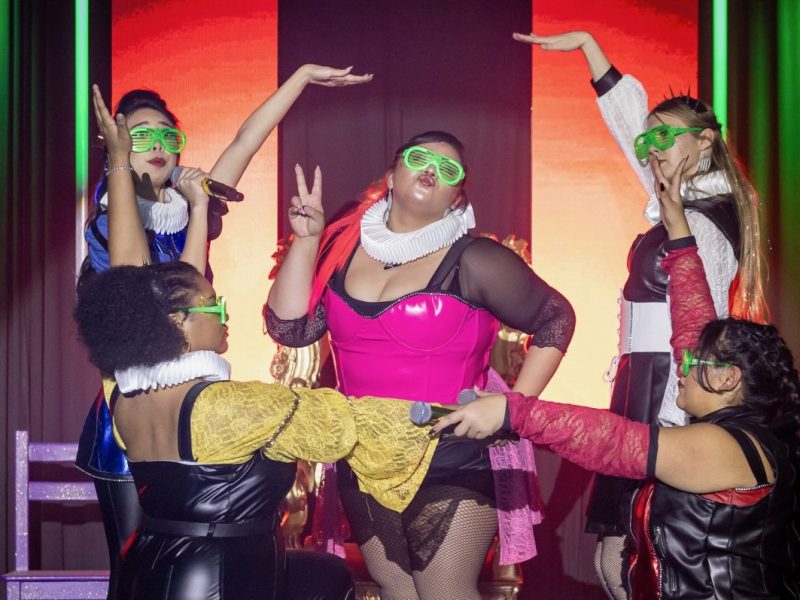

Five women named Betty get angry in UR Here Theater’s ‘Collective Rage’
By Donald Munro
UR Here Theater opens its fall reading series with Jen Silverman’s “Collective Rage: A Play in 5 Betties,” an acclaimed title that features — you guessed it — five characters named Betty. Haley White directs the staged reading, which will be presented for one performance only (2 p.m. Saturday, Sept. 14, at the 2nd Space Theatre). I caught up with White for a preview.
Pictured above: Camille Gaston is one of the Betties in “Collective Rage.” Gaston appeared in director Haley White’s photo series “Rage Face.”
Q: How did you first learn about “Collective Rage”? What drew you to it?
A: My friend Elyse played Betty 1 in the West Coast premiere of “Collective Rage,” at the Theatre at Boston Court in Pasadena, back in 2017. So I’ve known about the show for some time. I also really love Jen Silverman as a playwright in general. When Julie Lucido asked me if I wanted to direct this piece, I asked her if I could re-read the script and make sure it still jived with my current views on feminism (they’ve changed quite significantly since pre-pandemic times). I gave it a read and saw it was just as funny and modern and relatable as I remembered. It’s also a perfect script for a staged reading, in terms of style and length and themes; you can’t say that about all shows, no matter how good they may be.
Q: The characters are five women, each named Betty. Tell us a little about them.
A: Betty 1 is probably the most brimming with true, about-to-boil-over-at-any-second, rage. She is sick of her life and wants to punch everything in sight. Betty 2 is going through a bit of a mid-life crisis where she is figuring out what she wants and sort of thinking for herself for the first time. I feel like her rage is a great example of how female anger can be proactive, cleansing, and nourishing if you honor and listen to it.


Betty 3 is a hoot. She is charismatic, sarcastic, and full of life. Her rage shows itself in the form of biting insults and backhanded compliments.
Betty 4 is a bit of a philosophical sad-sack but, ironically, her character has one of the funniest moments in the show (when Camille Gaston demonstrates how to act as different types of walls. I promise, this moment is worth the price of admission alone).
Betty 5 is a genderqueer Casanova-type, who has built up a really solid presentation of themselves for the world to see. That image starts to crack a bit when someone sees them for who they are underneath it all. Their rage is, perhaps, the most subtle of all five characters. It’s the slow realization that they’ve allowed themselves to be a projection of a person rather than their authentic self, even while finding their definition of who they are from a gender standpoint. The play is about what happens when all these very different women crash into each other, and audiences witness how they all deal with insecurities, loneliness, anger, rejection, and stagnation in different ways but are all able to honor their own authenticity through different forms of evolution as well.
Q: Do the Betties interact with each other, or are all the moments solo?
A: Some Betties have closer relationships with one another than others do, but you’ll see them all interact at some point. There are also a few great monologues and a couple scenes where a certain Betty ‘creates’ a friend to talk to since she doesn’t have anyone else in her life.
Q: Without giving too much away, what are these women angry about?
A: They’re all seemingly angry about different things/angry with different people, but I think it ultimately comes down to them all feeling unseen and unheard. Each Betty goes on a journey to figure out who and what is responsible for that, and most of them realize they are culpable in their own disappointments.
Q: For those not familiar with UR Here’s play-reading series, can you quickly set the scene for us in terms of how the concept works?
A: Sure! The Reading Series is just that — scripts that are offered up as staged readings rather than fully produced shows. It keeps costs down for UR Here, lets actors who might otherwise be busy with other productions (or life events) participate because rehearsal commitment is low, and provides exposure for audiences to some great material that might not otherwise be seen in Fresno, at least any time soon. It started organically as a “Backyard Readers Theatre” in the pandemic; something that so many theatre-lovers in town participated in and enjoyed. Now, it happens in a slightly more formal setting on the second Saturday of certain months at Second Space Theatre in Tower District (thanks to the generosity of Dan Pessano). It’s a great way for people who love plays to hear plays and/or be in plays, and there is also always a talkback after every reading.
The Munro Review has no paywall but is financially supported by readers who believe in its non-profit mission of bringing professional arts journalism to the central San Joaquin Valley. You can help by signing up for a monthly recurring paid membership or make a one-time donation of as little as $3. All memberships and donations are tax-deductible.
Q: The other titles in the UR Here fall season appear to be election-themed. Does this one fall into that category, too?
No, this show isn’t directly election themed (although I feel pretty comfortable assuming that none of these characters would vote for a certain felonious, treasonist candidate if they lived in our timeline). The connective tissue that weaves “Collective Rage” with the other two titles is that they are all women-centric shows written by female/nonbinary (non-male) playwrights. I would say there is some collective rage happening in the other titles, too.
Q: Anything else you’d like to say?
A: First off, I somehow managed to score a cast for this reading that could really knock a full production of this show out of the park. Each one of these actors is uniquely suited to play their roles and I hope Saturday’s audience thinks they’re as hilarious and heartwarming as I do.
Secondly, anyone who knows me well knows that Female Rage is one of my favorite subjects to nerd out on. I did an entire chapter in my grad school thesis about it, and a few years ago, partnered with photographer James Ramirez to create a photo-series — “Rage Face” — on the subject. Betty 4 (actor Camille Gaston) and UR Here Treasurer and Founding Member, Julie Lucido (and her daughters), are in that series. I believe, like author Soraya Chemaly says, that “Anger isn’t what gets in our way — it is our way.” I think that was one of Silverman’s points when writing this piece, and I think she executes that theme incredibly well.