



Theater review: ‘The Sins of Sor Juana’ at Fresno State needs more of a spark
By Donald Munro
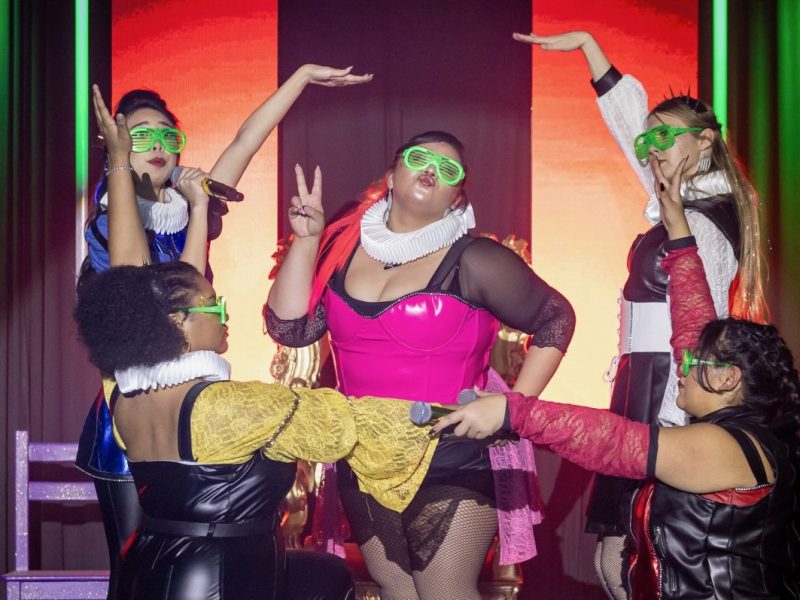
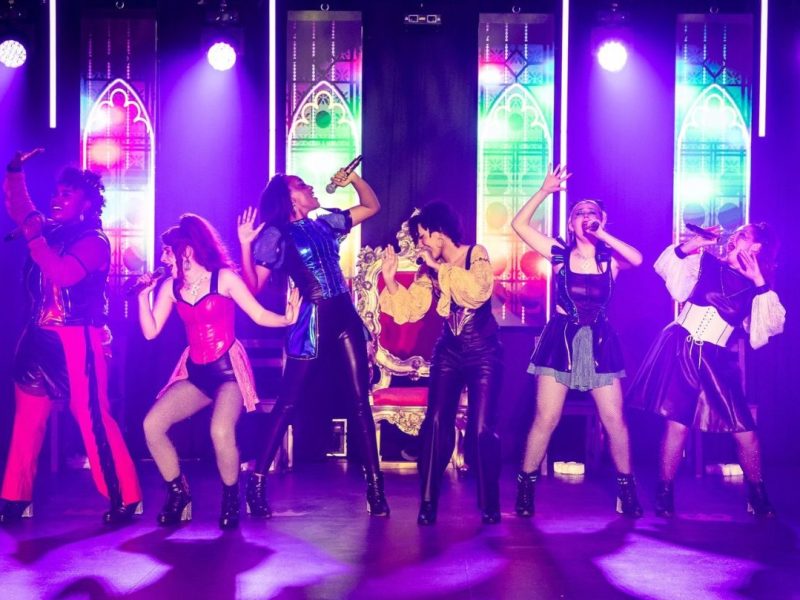
Try as I might, I couldn’t fall under the sway of Fresno State’s “The Sins of Sor Juana.” Director Gina Sandí-Díaz stages an earnest and handsome outing — complete with beatific stained-glass windows, impressive period costumes and a dusky, contemplative vibe– but the production itself never sparked for me in terms of the script, acting or staging. (The show closes Saturday, May 10, at the John Wright Theatre.)
Related story: A flame that won’t be extinguished: ‘The Sins of Sor Juana’ opens at Fresno State
The central character, Sor Juana Inés de la Cruz, is a famed Mexican historical figure. (She’s featured on the 200-peso banknote.) As a young woman growing up in the 17th century, she overcame her humble beginnings by using her ferocious intellect. She wound up in the palace of the Viceroy — the leader of the land — in a time when Spain controlled Mexico both militarily and religiously, Thanks to some friends in high places — particularly the Viceroy’s wife — she was indulged in terms of following her intellectual pursuits. In playwright Karen Zacarías’ telling of the story, Juana is a strong, bold figure willing to fight for her creative freedom.
Yet she couldn’t overcome society’s expectations for her as a woman. In the play, she flees from the palace after an arranged marriage falls through. She retreats to a convent, where she spends much of her time writing poetry.
The structure plays with chronology, flitting back and forth between the convent and the palace, and the theatricality with which Sandí-Díaz handles these transitions — characters march in with a burst of pomp through a standing wardrobe, say — are strong points of the show.
Zacarías’ script includes a fair amount of conjecture, which is natural, considering the haziness of the historical record from that era and the fact that most of Juana’s poetry was lost. I don’t begrudge the playwright’s speculations, but I’m a little surprised at the gimmicky heterosexual love triangle she constructed as the play’s main driver of the plot. The premise (one of the men hopes to woo Juana for cash and thereby get her thrown out of the palace, ) seems like an overused romantic-comedy trope. The far more intriguing potential storyline is underplayed: that Juana is attracted sexually to women.
As far as I know, no historian can confirm anything conclusive about Juana’s sexuality other than she wrote some especially good love poetry, some of it directed toward women. That hasn’t stopped folks today from claiming her as a lesbian icon. That angle is hinted at in terms of the Viceroy’s wife (a compelling Angelina Fleischhacker-Ruiz), who does seem quite enamored of Juana, but the playwright seems to shy away from anything tangible here. The attraction feels one-sided, pushed aside in the storyline by a couple of swashbuckling men eager to duke it out over their fair lady.


Beyonce Rodriguez-Fabela is a graceful Juana, and the two men battling for her favor (Thomas Estrada Jr. and Jonathan Rodriguez-Escamilla) have solid moments as well. Yet, overall, the production lacks urgency. The pacing is slow, humorous moments feel muted, and a seemingly never-ending stream of mellow classical Mexican guitar-style music in the background robs vital scenes of their energy. Yes, the music is of the period, but there are emotions raging up there on stage, and they occur against such a placid backdrop that we lose some of the impact. Sor Juana Inés de la Cruz is celebrated today as a towering figure and a rebel. I wanted more of that rebellious energy to come through on stage.
The Munro Review has no paywall but is financially supported by readers who believe in its non-profit mission of bringing professional arts journalism to the central San Joaquin Valley. You can help by signing up for a monthly recurring paid membership or make a one-time donation of as little as $3. All memberships and donations are tax-deductible. The Munro Review is funded in part by the City of Fresno Measure P Expanded Access to Arts and Culture Fund administered by the Fresno Arts Council.