



THEATER REVIEW: Good Company Players’ ‘Silent Sky’ twinkles with humor even if it doesn’t go supernova
By Heather Parish
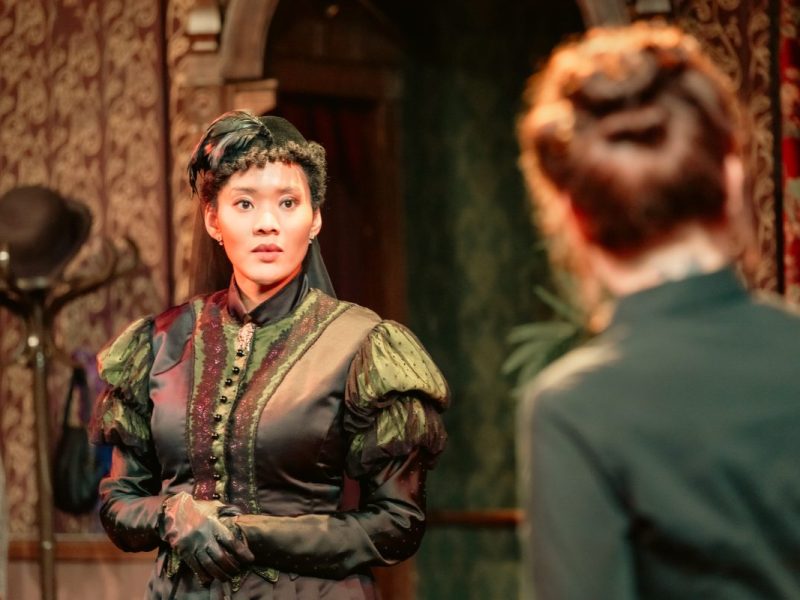
Never mind Einstein’s theory of relativity, mentioned briefly but importantly in “Silent Sky.” Lauren Gunderson’s 2015 play centers astronomer Henrietta Leavitt’s struggle to live uniquely and independently in a world that will let her do neither. While the talk is about calculating the mysteries of the universe, the meaning is decidedly earthbound in this entertaining drama directed by Laurie Pessano for Good Company Players.
Down to earth
Gunderson is known for stories about iconoclastic women, and “Silent Sky” deals with a multitude of women’s issues all at once. Such as the continual tension between the galactic ambitions of brash, bullish, decidedly brilliant Leavitt (Jessica Rose Knotts) and the mundane societal restrictions she experiences. She struggles to balance the “versus” that often comes with women’s lives: Work versus family; vision versus connection; legacy versus love.
The story follows Leavitt from 1912 to around 1920. She left her family farm to arrive at Harvard, taking a job as a “computer,” analyzing plates that contain images from the telescope at the Harvard Observatory. The women that do the necessary mathematical equations for the observatory’s research aren’t allowed to touch the telescope (that giant phallus is reserved for men), and any discoveries they make are soon absorbed by their male colleagues for their own careers. Amid all of this, Leavitt faces the disappointment of her sister, who cannot understand her need for independence; her supervisors who undervalue her work; and the missed opportunities for romance that could balance her perspective. Hers would be a sad tale if it weren’t for her great discovery that changed how we view the universe.
A solar system of characters
”Silent Sky” is very much an actor’s play, giving experienced actors a chance to interpret Gunderson’s character maps. This cast makes the most of the script’s opportunities for nuanced humor, sharp conflict, and difficult emotions.
Terry Lewis portrays Shaw, Leavitt’s immediate supervisor and eventual love interest. He’s an affable bumbler with a sweet spot for Leavitt, in whom he finds someone who does what he has never been able to do: step outside of the expectations imposed upon him and pursue a single-minded passion. Lewis conveys Shaw’s conventional misogyny of the time as merely misguided, leaving the worst of it to off-stage authority figures. As both a mediocre physicist and an eager suitor, Lewis brings a tenderness to the role along with a slapdash physical presence that is unusual for him.
Erin Brown delivers a sharp, pushy, and caring portrayal of Leavitt’s sister, Margaret. As Leavitt’s primary foil, she represents the choices left to women of a more conventional bent: marriage, children, elder care, and (perhaps) a pursuit of a creative passion as time allows. Her fears for her sister are palpable, and her own resentments bubble to the surface, making her an irksome yet sympathetic character. Brown’s performance also highlights how the sisters are very similar. With just one significant difference in outlook, we clearly see how differently their paths progress.
STORY CONTINUES AFTER SPONSORED CONTENT


Supporting Leavitt’s ambitions are fellow Harvard “computers” Annie Cannon (Valerie Munoz) and Williamina Fleming (Aurora Nibley). Munoz and Nibley provide much of the pointed comedic relief, but they also slyly undercut the conventions of the prim, staid mathematician. Munoz’ slight build belies Cannon’s huge force of personality, while Nibley’s amiable smile and Scottish brogue give way to quick observations and a challenging spirit. Together the pair complete a dynamic scene circling Leavitt.
Rotating around the sun
As Leavitt, Knotts occupies center stage in the story, operating not only as the protagonist but also as the story’s engine. The story portrays Leavitt as brash, overtly funny, and somewhat resentful of the polite euphemisms expected of her. Graceful and well-spoken with a keen presence, Knotts is easy to watch on stage and appeals to audiences. However, in her portrayal of Leavitt, Knotts may come across as a bit too smooth to effectively convey the character’s rough edges. She nails Leavitt’s family affection and humor. But in Leavitt’s self-absorbed, less likable moments, Knotts never pushes her character into territory that could sting the more conventional characters in her midst. Knotts finishes each beat with a smile, never souring a scene. The resulting performance is limited, like a piano concerto that never leaves C major to add something sharper or flatter in the mix. I believe Knotts’ capable skills could be enhanced by adding a bit more flint to ignite something new.
Floating in a galaxy
The production itself makes some excellent choices in terms of design and approach. Pessano’s direction is smooth, a few clunky blocking moments notwithstanding. (A few scenes where Knotts is downstage left seemed to put her entirely offstage; she was so dark.) David Pierce’s set is a little black dress of a design, making use of the void-like darkness of the stage to highlight galaxy and star projections by Don Thompson Creative Services. Joielle Adams’s lighting design stretches to create some stage magic that transforms the space, and it mostly succeeds despite the limitations of the ¾ thrust stage in the 2nd Space. And the costumes by Ginger Kay Lewis-Reed are nicely done.
Into the universe and back to Earth
The performance comes in at just under two hours. While the first act feels a little long, “Silent Sky” is possibly Gunderson’s funniest play, so that helps things along. However, all of the talk questioning the truth of the universe is a MacGuffin. The play primarily addresses the issues of women’s ambition and their limited roles right here on Earth. It is about how women didn’t—and often still don’t—have enough space (ironically) to be everything that they can and want to be.
And it does this very well. It is funny, entertaining, and accessible for a wide variety of audiences. While it occasionally has the cadence of a young adult novel, it is of the kind that can satisfy curious teens and parents alike.
“Silent Sky” runs at the 2nd Space Theatre through June 22.
The Munro Review has no paywall but is financially supported by readers who believe in its non-profit mission of bringing professional arts journalism to the central San Joaquin Valley. You can help by signing up for a monthly recurring paid membership or make a one-time donation of as little as $3. All memberships and donations are tax-deductible. The Munro Review is funded in part by the City of Fresno Measure P Expanded Access to Arts and Culture Fund administered by the Fresno Arts Council.