



THEATER REVIEW: Fast, Fast, Fast? Not quite. GCP’s ‘Shrew’ falters in the footsteps of ‘Laugh-in’
By Heather Parish
Let’s face it. We all need a laugh these days, and a “Laugh-in”-style Shakespearean comedy seems like it would fit the bill. “The Taming of the Shrew” features some of the Bard’s most pointed comedy, and “Laugh-in” was sharp, chaotic, and subversive for its time. While both “Taming” and “Laugh-in” have some trouble connecting with 21st century audiences, I was intrigued by the idea of a Shakespearean play delivered in the style of the ‘60s variety show, and I looked forward to a zany, zippy night of theater. Despite its potential, this production did not deliver.
Look that up in your Funk and Wagnalls!
“The Taming of the Shrew” pits the sharp-tongued, strong-willed Kate (Shelby Guizar) against the equally bold Petruchio (Joshua Shadle), who sets out to “tame” her so he can claim her substantial dowry in marriage. Meanwhile, suitors Lucentio (Anthony teNyenhuis), Gremio (Noah Miranda), and Hortensio (Jorge Romero Vaca) compete for the hand of her younger, more demure sister, Bianca (Madeline Wristen). Their efforts are stalled, however, by their father’s (Ken Stocks) decree that Bianca cannot marry until Kate does. And Kate refuses. Through disguises, deceptions, and various shenanigans, Shakespeare sets up a battle of wits that questions gender roles, power, and equity in marital relationships. When a director opts to set the play at any time after the year 1900, the scenario requires sharp satire and clever inversions to be satisfying to a modern sensibility.
Sock it to me!
In 1968, “Rowan and Martin’s Laugh-in” was a groundbreaking achievement for television comedy. At a time full of bad news and stuffy entertainment formulas, it broke the mold, departing from the staid, Milton Berle comedy style that dominated variety shows of the 50s and 60s. (The section titles in this review are some of the “Laugh-in” catchphrases that lasted a couple of decades.)
“Laugh-in” writer Paul Keyes said at the time, “I don’t think anybody would dare stay with the old-fashioned, long sketches any more. They’ve got to speed up, present more funny, lovable people, get more jokes in. This show is right for the time, darling, when an hour of laugh, laugh, laugh is sorely needed.” The New York Times’ culture critic Joan Barthel agreed: “Whatever else it is — and at one time or another ‘Laugh-in’ is hilarious, brash, flat, peppery, irreverent, satirical, repetitious, risqué, topical and in borderline taste — it is primarily and always fast, fast, fast! And in this it is contemporary. It’s attuned to the times. It’s hectic, electric. . . “
One ringy-dingy … two ringy-dingys
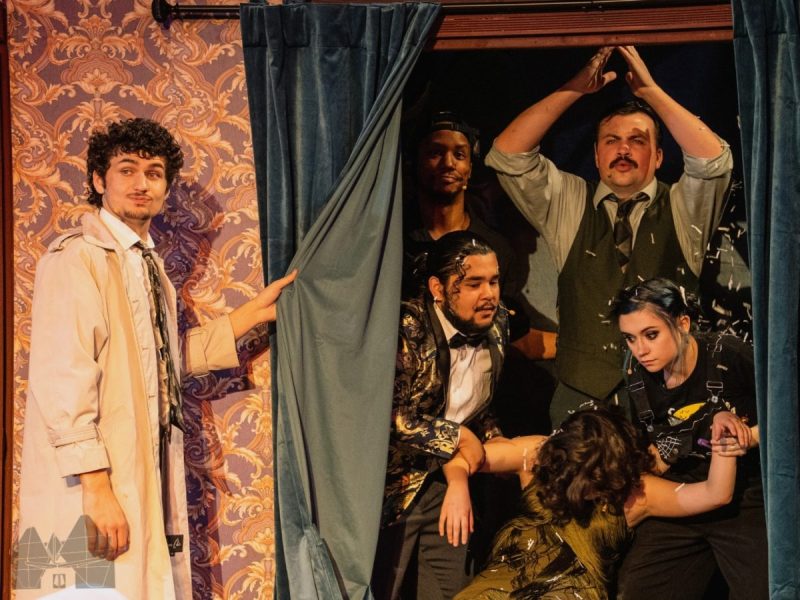
The set, mimicking the “Laugh-in” studio set with psychedelic swirls and pop-in windows, immediately put a dance in my step upon entering the Nancy Miller Stage in the 2nd Space Theatre on opening night. Later, I was sad that the “Laugh-in” concept didn’t extend very far beyond David Pierce’s set and Ginger Kay Lewis-Reed’s mod costumes. Ultimately, Herring’s starchy, tentative staging didn’t achieve the “Laugh-in” mission of “laugh, laugh, laugh” or “hectic, electric,” despite the potential of the concept.
Have I reached the party to whom I am speaking?
If this “Taming” is to be an extended sketch in an episode of “Laugh-in,” it doesn’t go far enough into camp, quick-cuts, catchphrases or side-takes to keep the laughs rolling in. The scene work is slow and seems more concerned with standing at the right camera angle than engaging with scene partners.

Also, the addition of repeated pantomimes and dances as intros to pivotal scenes just elongates the story, providing unnecessary exposition for what is perfectly obvious as the scene starts. These little tableaux may be inspired by “Laugh-in,” but they are too quiet, too slow, and too slim on sight gags to prime the audience as they wait for the next scene. It’s an unnecessary conceit and weakens the pacing of the show.
You bet your sweet bippy!
 One of the reasons “The Taming of the Shrew” is still often produced today (instead of, say, Shakespeare’s “Titus Andronicus”) is that Kate and Petruchio are probably second only to Beatrice and Benedick in terms of audience affection. Each couple has its own spark, its own dynamic, and its own loveability quotient to keep people coming back. In “Much Ado,” most of the attraction is the long-standing intellectual sparring between Bea and Ben. In “Taming,” most folks chalk it up to the palpable sexual tension and how both are stirred—downright gobsmacked—by the other throughout their scenes.
While Guizar and Shadle do everything they can to keep the zingers coming, there is little to no chemistry between the two. That comes down to how they look at each other, listen to each other, and touch each other. These areas need more focus from the direction.
Ring my chimes!
The rest of the coupling stories are equally prim in their execution. Nary a hint of a make-out session, a roll in the hay, or a single impropriety is alluded to on the stage, giving us none of the sex appeal of neither “Laugh-in” nor “Taming.” Which may be a blessing considering how Bianca and Kate are skipping rope and playing finger string games like grade schoolers. (What?!)
The Munro Review has no paywall but is financially supported by readers who believe in its non-profit mission of bringing professional arts journalism to the central San Joaquin Valley. You can help by signing up for a monthly recurring paid membership or make a one-time donation of as little as $3. All memberships and donations are tax-deductible. The Munro Review is funded in part by the City of Fresno Measure P Expanded Access to Arts and Culture Fund administered by the Fresno Arts Council.
Without the dichotomy of raging sex drives and purity culture that “Taming” inevitably sets up, how are we supposed to understand the importance of Bianca’s eventual defiance? Where do we see the widow’s attractions for a man looking to wed hastily? There is a lot of sexy humor straight out of “Laugh-in” waiting in the wings here, but it never arrives.
Beautiful downtown Burbank
Now, lest we think I found nothing of worth in this production, let’s discuss some bright spots or places that had potential for growth on opening night:
- The uneven community cast is gaining fluency with the early modern English of Shakepseare’s language. While not always clear or related to their actions, this mostly novice cast is clearly learning.
- teNyenhuis is effortless in his charm, and Nico DiVicarro’s comedic timing as Tranio is excellent. Character actors Miles Mellon (Grumio) and Guinevere J. Thelin (the Pedant) make the most of supporting roles full of physical comedy. They both fully commit to “the bit.”
- Wristen’s Bianca rises above her childlike portrayal in the final scene with aplomb. Guizar’s Kate is appropriately cantankerous and has the beginnings of a good portrayal. If she can find Kate’s wild, threatening, desperate, and playful elements to mix in, she will elevate her skills here

- Shadle’s Petruchio has potential with a solid stage presence and voice. I appreciated his initial appearance in the play as a calm, cool character staking out opportunities in the bohemian Padua. If he can find more challenge and surprise in Kate, he’ll move beyond the straight-man persona and grow as a partner (and as an actor).
- The iconic “Laugh-in” set windows for characters to pop in and out of allowing for asides, eavesdropping, and introducing new scenes has its clever moments, but it missed a few opportunities for a few “veeeeery interestink . . . . but stupick!” “Laugh-in” catchphrases to roll through the action.
- The music cue selections supported the action and at times were subversive and clever. “You Don’t Own Me” in front of a wedding scene is priceless.
All of this is to say that this cast has potential and I believe I saw glimmers of “what could have been” and “what could be,” but it is stymied by slow pacing and a lackluster attempt to meet the demands of the “Laugh-in” concept.
Is this version of “Taming of the Shrew” right for the time? I question whether “Taming” ever is, but I know a number of actors who would disagree with me on that. So, yes, perhaps there are versions of “Taming” that could be both hilarious and right for the time. This one, however, didn’t meet that “Rowan and Martin” mark.
“The Taming of the Shrew” continues at Good Company Players’ 2nd Space Theatre through Aug. 17.

Katherine Seiler
Great review. Very knowledgeable. I was in my mid-20s when Laugh in emerged and now I’m in my 80s. I can’t figure out how you knew so much about a series almost 60 years old. Your review brought back a lot of great memories.
Steph
“Ring my chimes?” I don’t recall that from Laugh-In and I watched every episode. Even Google AI couldn’t figure out that one.
You could have been dramaturg for this show based on your review! Double Dramaturg – except then you would have known it would be “verry interesting – but shtoopid.”
Thanks for the review tho – now I know to wait a couple weeks to see it to let the cast settle in.