




Five things to love about Children’s Musical Theaterworks’ ‘Bye Bye Birdie.’ Plus: You can win a four-pack of tickets to Friday’s performance.
By Donald Munro
With the earworm-lyric “going steady” going steadily through my brain since Sunday, it’s safe to say that I enjoyed the big, hearty production of “Bye Bye Birdie” at Children’s Musical Theaterworks. My take isn’t a typical review because we’re talking about children’s theater (although at a very high level) performed by mostly teenagers. I will, however, muse on some of the specific aspects of the show that I really liked.
(The show is double cast. I saw the Sunday matinee on the first weekend featuring the Hummingbird cast. The run continues at the Fresno Memorial Auditorium Theater with performances at 7:30 p.m. Friday, July 18; 2 and 7:30 p.m. Saturday, July 19; and 2 p.m. Sunday, July 20.)
Before I get to my notes on the show, here’s a great ticket giveaway to consider:
I’m giving away two four-packs of tickets to Friday’s performance.
Ticket giveaways are open to members, donors and individual sponsors of The Munro Review. A free basic membership is available, and paid memberships start at $5 a month. (You can always opt for a one-time donation of as little as $3.) I love signing up new free members, but even better is adding members who are willing to financially support local arts journalism. It’s the only way this site can continue to stay alive. Memberships and donations are tax-deductible; this is a non-profit site under the fiscal sponsorship of the Community Media Access Collaborative (CMAC). To become a member, click here.
To enter, leave a comment on this post telling us if you remember using a telephone with a cord. Deadline to enter is 11 p.m. Thursday. I’ll let the winners know by email first thing on Friday morning.

Now, on to my Top Five aspects and moments in the show that I like:
The direction. Randy Kohlruss takes an enormous cast, dozens of musical numbers, multiple settings, two rather strange ballet sequences and a complicated narrative – and still manages to keep things smooth and brisk. (The book, by Michael Stewart, can feel a bit clunky and obsolete; the opening scenes, for example, throw a lot of exposition at the audience in an old-fashioned way.) Kohlruss keeps the energy up and the laughter prominent. Besides, the plot isn’t all that hard to follow: A hunky, hip-swiveling pop singer named Conrad Birdie (loosely based on Conway Twitty, but there’s also a lot of Elvis in the character) is about to be drafted, and his record label sends him to small-town America to bestow “One Last Kiss” on a randomly selected 15-year-old girl.
 Children's Musical Theaterworks
 Isaac Mora Zuazo, left, and Ella Rutiaga perform in “Bye Bye Birdie.”
Ella Rutiaga as Rose Alvarez. Her strong voice and dance moves shine, and her performance of the song “Spanish Rose” – perhaps the thorniest moment in the show when it comes to racial politics – comes across not with anger or condescension but with a faintly snide aplomb. Directors and audiences for years have tried to figure out how to keep revivals of the show from coming across as racially offensive, mostly because of the scripted anti-Latino sentiments of Rose’s nightmare future mother-in-law, Mae (played with a persuasive bluster by Natalia Priolo.) I think Rutiaga’s self-confidence and take-charge attitude as Rose is probably the best antidote to the overt, dated obnoxiousness of the material.
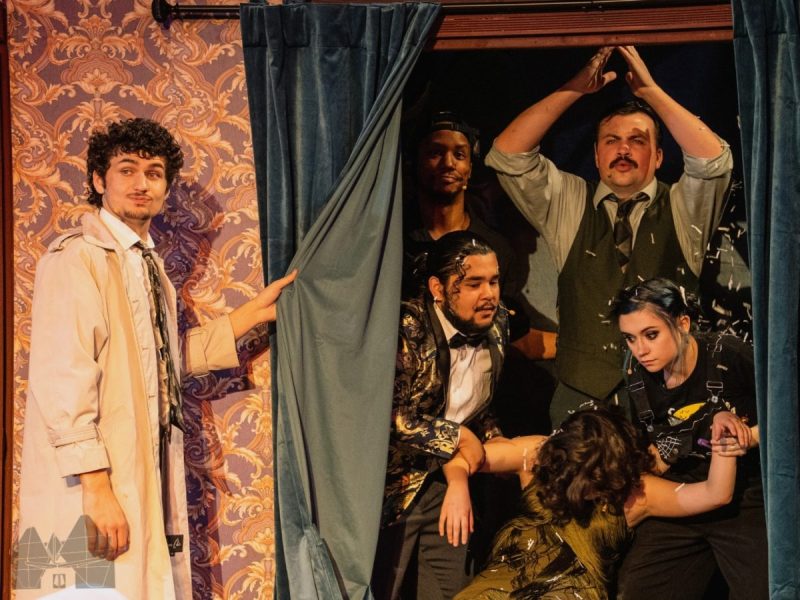
Other talented performers. Isaac Mora Zuazo is a standout as Albert Peterson. He has the frantic, nebbish energy needed to make you almost believe that Albert could be a big-deal record executive. He has the charisma to command the stage. Abrahan Barajas, with a towering pompadour and shiny attire (there are so many fun costumes in the show, with credit to Emma Raymond, Justice and Peyton Cables), puts on some full-scale swoon as Conrad. Arturo Nevarez and Syd Galaviz, as put-upon parents, belt out “Kids” with style. Also, in a small but mighty role, Samantha Shaheen Smith plays uber fan Ursula with more enthusiasm per square syllable than you might think humanly possible. She made me laugh.
The look of the show. Dan Aldape’s sound and light design is stellar, as we’ve come to expect. What I like most is how the projections integrate with the scenic design (by Kohlruss). For example, I love the roll-on-unit bedroom set of Kim, the Conrad fan club president (played with a perky, nicely voiced intransigence by Noah Coleman). The textures, colors and details add a solidity to Aldape’s digital backdrop. My favorite visual moment in the show: a rack of garbage cans on a Sweet Apple Street. There is a mix of “real” and digital streetlights (a piercing bright yellow) against an aqua background dominated by groovy ‘60s hourglass and asterisk shaped designs. Best is a large, funky purple object that sort of reminded me of a surrealist Sputnik. The resulting blend of three-dimensional set pieces and the projection is just perfect in terms of proportion and depth. It’s the type of scenic design you could see on Broadway.
The Munro Review has no paywall but is financially supported by readers who believe in its non-profit mission of bringing professional arts journalism to the central San Joaquin Valley. You can help by signing up for a monthly recurring paid membership or make a one-time donation of as little as $3. All memberships and donations are tax-deductible. The Munro Review is funded in part by the City of Fresno Measure P Expanded Access to Arts and Culture Fund administered by the Fresno Arts Council.
The choreography. I had forgotten just how, well, odd some of the dance numbers are in “Bye Bye Birdie,” and it’s a testament to Kohlruss’ reverence toward the source material that he includes a couple of numbers (“One Hundred Ways Ballet” and “Shriner Ballet”) that might be cut in modern versions. “One Hundred” is Rose’s fantasy about all the ways she’d like to kill Albert; let’s just say a severed head gets thrown into the orchestra pit. Choreographer Maria Monreal shows a lot of creativity in exploring various ways to die, and she offers a more palatable version of “Shriner Ballet” (another odd number) than I’ve seen in other revivals. She shifts Rose from vixenish sex symbol to more of a kindergarten teacher leading her students. (I loved the human rolling pins.)
How much you view “Bye Bye Birdie” as satirical will depend, I’m guessing, on the lens through which you view the structure of American society. Some will latch on to the small-town American values typified by Sweet Apple and see it as nostalgic; others will roll their eyes at the quaint, dated notions of gender and race. (The song “How Lovely to be a Woman” practically begs to be performed in drag.) For me, the best part of watching young performers in an oldie-but-goodie show like this is seeing it through their eyes. In “The Telephone Hour,” which sparked that “going steady” earworm for me, the kids have to use these strange receiver handles with cords attached. Imagine that.

Patty
I do remember using a phone with a cord. Our telephone number was 20441.
Courtney Bautista
My most memorable corded phone was the one I had as a teenager in the early 90s. It was made of clear plastic, had a rainbow cord and lit up with neon lights when it rang. That said, corded phones aren’t a thing of the past for me…my desk phone at work has a cord and I love to collect vintage rotary phones too.
Kristal Smith
I totally remember using a corded phone and being stuck near that part of the house because you can’t walk around like you can with a cordless phone.