




With grants behind schedule, Measure P tensions flare as some artists demand equity and transparency
By Doug Hoagland
As officials scramble to satisfy grassroots artists who succeeded in halting the release of Measure P grants, it now appears mid-to-late October will be the earliest opportunity to award $6.3 million to more than 130 artists and organizations.
As of Oct. 1, the 2025 grants program already is three months behind schedule. In an attempt to avoid further delay, officials announced at a tension-filled meeting on Sept. 29 what some believe is a significant move toward greater transparency – a key demand of the grass-roots artists. An important subcommittee in the Measure P universe that previously met behind closed doors will move to publicly open meetings guaranteed by state law. (The first one will occur at 4 p.m. on Monday, Oct. 6, at City Hall.)
But that might not be enough to satisfy critics.
The major sticking point appears to be recordings of discussions among community volunteers who scored applications for Measure P funds. Grass-roots critics say bias marred the scoring and that the recordings could prove it. The Fresno Arts Council defends the integrity of the program. It has declined to release the recordings, according to Ome Lopez, a member of the grassroots Coalition for Fresno Arts. Lilia Gonzáles Chávez, executive director of the Fresno Arts Council, did not respond to The Munro Review’s inquiry about the recordings.
The saga of Measure P: See past coverage in The Munro Review’s comprehensive archive
If an impasse continues, the city’s Parks, Recreation and Arts Commission could be in the position of opting for further delays or moving ahead despite opposition, a move likely to generate even more opposition and controversy.
How the interested parties deal with the controversy will be the legacy of the second year of Measure P arts grants. As happened in the inaugural 2024 round of funding, the process of awarding grants in 2025 has at times overshadowed the greater purpose of Measure P to invigorate the city’s cultural scene.
STORY CONTINUES AFTER SPONSORED CONTENT


This latest chapter in Measure P’s rocky history – a byproduct of a new program with millions of dollars on the table – played out at the Sept. 29 meeting of the Parks, Recreation and Arts Commission. The Commission originally was scheduled to vote at that meeting on recommended funding, which could have brought the 2025 grant program to a conclusion.
Instead, the Sept. 29 meeting saw 49 speakers address the Commission, with many acknowledging that reforms are needed to the grants program going forward. But they urged the Commission to finish its work and award the money to recommended applicants this year.
“All I’m asking is you be pragmatic,” said Bruce Kalkowski, former board president and current board member of the Fresno Arts Council. “Give the people their money that they’ve already won, and we’ll work through the process so it gets better and better each year.”
But Desirae Washington, who said she is recommended to receive a Measure P grant in 2025, urged the Commission to act now to address issues raised by the Coalition for Fresno Arts. Those issues are:
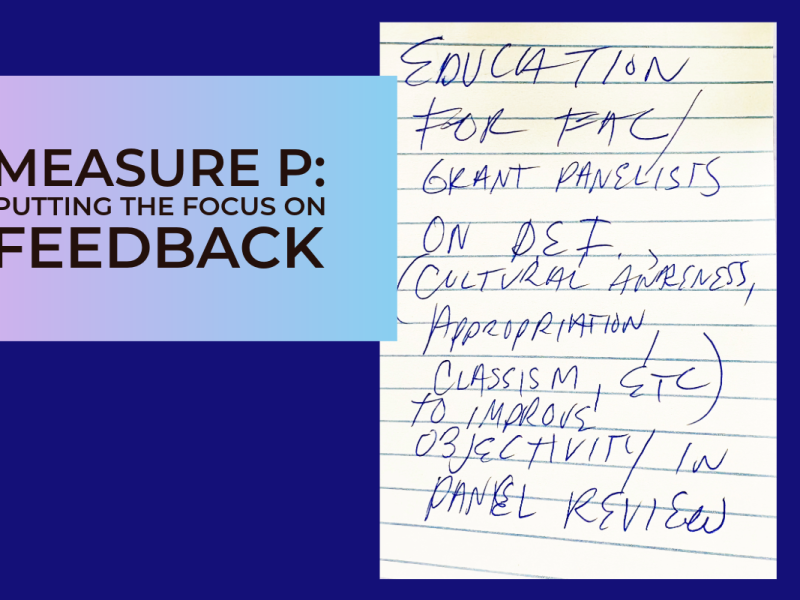
• Alleged bias by the Fresno Arts Council staff in overseeing the scoring of grant applications by community volunteers.
• Lack of transparency by the Commission’s Cultural Arts Subcommittee, which made the now-stalled funding recommendations to the full Commission for final consideration. The recommendations identified successful applicants and the amount of Measure P money they would receive.
• Current funding recommendations that would allocate approximately $5 million to established arts organizations and $1 million to grass-roots artists and smaller organizations.
“Tonight, I am making a plea,” Washington said. “Let this be the time we do things differently. Let this be the time we choose transparency over manipulation, equity over privilege, community over connections. Let this be the time we break the cycle that has defined Fresno for far too long.”
The Sept. 29 meeting took an emotional, even personal, turn at times. Lopez of the Coalition for Fresno Arts came to the speakers podium but turned to address Gonzáles Chávez, who was sitting in the audience.
 Photo by Doug Hoagland / The Munro Review
 Arts supporters attend the Sept. 29 meeting of Fresno’s Parks, Recreation and Arts Commission.
Lopez, co-founder of Dulce UpFront, a nonprofit arts organization, spoke about a confrontation she had with Gonzáles Chávez on Sept. 15 at Dulce UpFront’s space near Fresno High School. Lopez did not go into every detail about the confrontation before the Commission but did say she and Gonzáles Chávez disagreed that day about how much power Gonzáles Chávez has over Measure P. Lopez said on Sept. 29 that she came away from that confrontation feeling mocked and embarrassed.
The Munro Review was present and observed the confrontation when it occurred but did not hear the conversation. Lopez had convened a meeting to get opinions and experiences from 2025 grant applicants, and Gonzáles Chávez arrived, wanting to attend the meeting. Lopez turned her away. Lopez said she told Gonzáles Chávez that the assembled 25-30 people needed a safe space to candidly express themselves and that Gonzáles Chávez’s presence would create a power dynamic making that difficult.
Gonzáles Chávez appeared unhappy as Lopez spoke to her outside the glass front door at Dulce UpFront. “She was upset,” Lopez later told The Munro Review.
Gonzáles Chávez declined to talk to The Munro Review as she left the Sept. 29 meeting, and she did not respond to a follow-up message seeking comment. Speaking to the Commission, Gonzáles Chávez said the Fresno Arts Council championed from the earliest days of Measure P the goals of inclusion and equity. Furthermore, she said, the Arts Council is open to hearing from people with ideas about the grants program.
Lopez said she disagrees about the Arts Council’s openness. In the interview with The Munro Review, she said it’s essential that the recordings be released so grant applicants can determine if there were errors or bias by the Arts Council staff that affected scoring, and by extension, funding recommendations.
The recordings were made after community volunteers individually scored the same applications and then met to discuss their scores. Applicants could attend the meetings, but not speak. Lopez has said that some applicants did not receive adequate notice of the meetings, which caused them to miss the meetings.
In addition to the release of the recordings, Lopez said the Coalition wants the following actions:
• Another 10 business days for appeals so applicants could submit paperwork based on what the recordings reveal.
• Surveys or focus groups where applicants could share their concerns and ideas for improving the grants program.
• Changing representation on the Commission’s Cultural Arts Subcommittee to better reflect Fresno demographics. Currently, Commissioners Laura Ward, Scott Miller and Jon Dohlin comprise the Subcommittee. They all appear to be white, while Hispanics comprise a majority of Fresno residents.
Lopez told The Munro Review that the Coalition is not asking for 2025 grant applications to be rescored and new funding recommendations issued. She was less definite about whether the Coalition is considering legal action against the city over Measure P. “We have not come to that point,” Lopez said. Asked if that option is on the table, she repeated that statement.
The role and influence of the Cultural Arts Subcommittee has become a flash point in the current standoff. Lopez and other grass-roots critics have objected to the Subcommittee functioning as an “ad hoc” group and therefore not subject to the Brown Act, the state’s open meeting law. But a major change is coming, according to Commissioner Ward.
The Munro Review has no paywall but is financially supported by readers who believe in its non-profit mission of bringing professional arts journalism to the central San Joaquin Valley. You can help by signing up for a monthly recurring paid membership or make a one-time donation of as little as $3. All memberships and donations are tax-deductible. The Munro Review is funded in part by the City of Fresno Measure P Expanded Access to Arts and Culture Fund administered by the Fresno Arts Council.
At the Sept. 29 meeting, Ward announced that City Attorney Andrew Janz has agreed that the Subcommittee can voluntarily hold open meetings almost immediately. “Sunshine drives out the darkness, and this is a step we can take right now to help restore public trust,” Ward said. On Wednesday, Oct. 1, Ward said the Subcommittee would convene the open meeting on Oct. 6 at City Hall. In this way, the public “can join us and review the same material” that the Subcommittee considered in making the now-stalled funding recommendations to the full Commission, Ward said.
After that meeting, the goal is for the Commission to vote in October on releasing the $6.3 million, Ward said. The Commission is scheduled to meet on Oct. 13 and Oct. 27. Furthermore, Ward said, Janz has said the Commission can take future action to make the Subcommittee a “standing” committee and therefore subject to the Brown Act. In other words, the change will be permanent, according to what Ward said.
Asked whether that change is enough to restart the grants process, Lopez of the Coalition for Fresno Arts said recordings and transcripts of community volunteers discussing grant applications must be released by the Fresno Arts Council.
Other speakers at the Sept. 29 meeting included:
• Julia Copeland, a violinist with the Fresno Philharmonic (which is recommended to receive $240,000 in Measure P funds) and a board member of the Fresno Arts Council. “Measure P is the best thing since sliced bread,” she said, adding that Fresno’s arts community has “subsisted on very little bread for decades.” Copeland called for the 2025 grant money to be released immediately and reforms considered in the 2026 grant cycle.
• Alicia Rodriguez, chair and co-founder of the Labyrinth Art Collective, which is recommended to receive $89,430 in Measure P money. “Yes, we want our money, too, but we would be remiss to not join with others in the community demanding a transparent and equitable process. How can we move forward when the scores are tainted? There have been documented biases . . .”
• Julio Hernandez, executive director of Chicanismo in Color, a Chicano lowriding art project, which is recommended to receive $30,000 in 2025. “I have multiple complaints about Measure P. My complaint is I can’t thank everyone enough.” Hernandez thanked the Parks, Recreation and Arts Commission, the Fresno Arts Council, his Measure P fiscal sponsor, the Alliance for California Traditional Arts and others. “I’m grateful for one penny or multiple pennies.” He added that navigating the grant process is hard, “but it made me grow. It made me a better businessman.”
• Jon Dohlin, one of the nine members of the Parks, Recreation and Arts Commission. He addressed the tension caused by grass-roots artists and organizations charging that the grants program favors larger, legacy arts organizations. No arts organizations, large or small, are thriving in Fresno, said Dohlin, who is chief executive officer of the Fresno Chaffee Zoo. “Everybody is on the edge [financially], and everybody is trying really hard.” He added: “I do think we’re fighting against each other, and that does not seem very productive at the end. There is time for this to improve.”
Measure P is a 30-year, ⅜ cent increase to Fresno’s sales tax that city voters approved in 2018. It will generate millions of dollars over three decades, with 88% going to boost parks and 12% dedicated to the arts grants.



Steph
I have no dog in this fight. I only know what I read (thank you Doug!).
So my unasked-for opinion is to release the money already.
It’s only the second year. The complaints seem valid from what little I know, but good golly, give them time to absorb the criticisms and the (extended) time to figure out the kinks.
We give new team coaches three years to get their own recruits in, we have to do the same here.
I mean, goodness! All of a sudden the city had millions(!) of dollars to figure out – and when you’re talking that kind o’ cash? Erryone wants their fingers in the pie.
Arts (and parks) are getting a nice boost. Very nice!
But let’s take those concerns to heart, as I know/hope you will.
Haley White
Maybe if you had a dog in the fight you might give a shit about how horribly biased, inconsistent, and non-transparent the process was from start to finish. These aren’t small complaints Lopez and others (like me) are raising. We’re talking direct interference from FAC, no set rubric for scoring, lack of education and training and downright bullying of some panelists, inequitable disbursement of funding, decisions being made behind closed doors, and a whole host of other problems. The well is poisoned. You don’t drink what’s left of the water and say next time you’ll fill it up with less poisoned water.
Stephanie
I too have no dog in this fight, but I’m disgusted by Jon Dohlin’s comments and his blame of those in the community who are asking for transparency and fairness. I think he needs to step down from this role as he clearly does not have the arts community’s best interests at heart. I’m disgusted by the fact that the recordings haven’t been released. I’d like to know how the three chairs of this committee were chosen and why the committee does not reflect the demographics of Fresno. I’m also surprised that grant applicants were eligible to serve as reviewers. This should be changed.