



Theater Review: A gritty, imaginative “Salomé” from Fresno City College
by Heather Parish
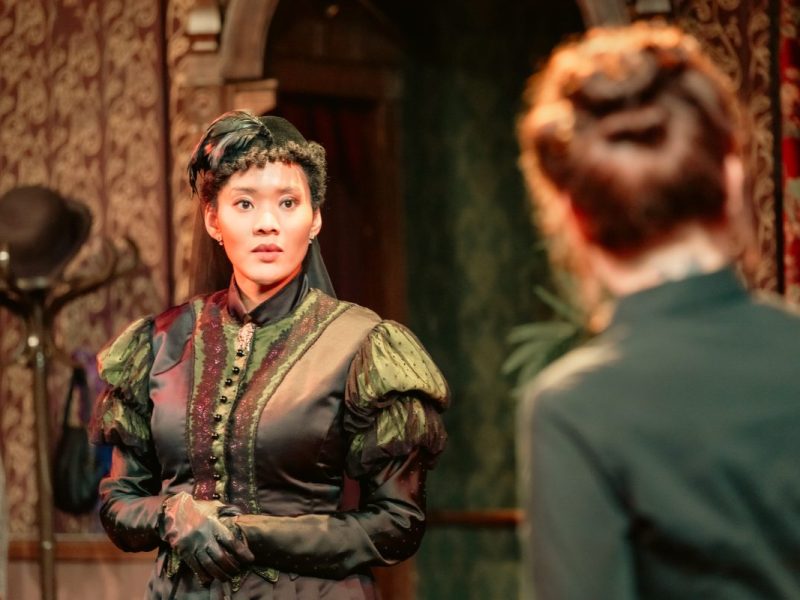
Oscar Wilde’s “Salomé” is a fever dream of desire, power, and obsession. A lyrical one-act steeped in Biblical lore and symbolic sensuality, it’s also a challenging assignment for student artists. Fresno City College (FCC) Theatre Department’s new production, directed by Summer Session-Plevny, embraces that challenge with an ambitious staging and a physical, full-throttle approach that leans into the play’s intensity. While not every moment lands with equal force, the production’s imaginative design and committed performances offer a bold encounter with a lesser-produced Wilde play.
A slowly fading environment
Session-Plevny and her design team transform the FCC black box theater into a vertical, industrial wasteland: catwalks, ladders, poles, platforms, and enough weathered detritus to suggest civilization long past its prime. It’s a Mad Max–styled post-apocalypse, a world of scarcity where power is hoarded, bartered, or stolen. The scenic design by Johnny Cano and Christina McCollam-Martinez is more than scenic decoration; it gives actors room to climb, slide, hang, leap, and stalk. Session-Plevny uses every level of the space with gusto and the overall effect is kinetically arresting.
The lighting design, also by McDollam-Martinez, enhances the setting’s bleak allure. Much of the world is cast in dim, half-light—shadowy, moody, and limited in visibility, as though the environment itself were slowly fading. Wilde’s script refers often to the moon, and the production’s murky palette supports that reference. This is a world where illumination is partial, emotional motives are obscured, and danger might lurk just past the edge of sight. The sound design by Ronny Bounthapanya underscores this environment, though it sometimes competes with ensemble’s diction.
The production’s narrative clarity is solid overall, though audience members unfamiliar with the Biblical background may miss some of the story’s context—particularly that Jokanaan is John the Baptist, or that Herod’s fascination with Salomé culminates in the prophet’s famous end.
A standout quartet
STORY CONTINUES AFTER SPONSORED CONTENT


Among the standouts in the cast is Jimmie Haynie as Herod, who gets the assignment and turns it in with relish. His Herod is part tyrant, part nervous showman, and part self-deluded sensualist—antic yet oddly sympathetic. Haynie excels at building tension in his scenes, pressing Bri Villanueva-Hardcastle’s Herodias and Zelia Ankrum’s Salomé to rise to his level. His performance becomes the production’s gravitational center.
Bri Villanueva-Hardcastle is a sharp counterpoint as Herodias, bringing the sly, watchful energy of a mob boss’s wife. Her dry humor and simmering irritation spark beautifully against Haynie’s volatility. Together, the pair’s scenes crackle with comic wariness and political maneuvering. Alexander Gonzalez delivers a vocally robust, physically demanding Jokanaan. His considerable presence makes Salomé’s fixation on him feel credible, even inevitable.
In the title role, Zelia Ankrum brings a freshness to Salomé. She is especially strong when the character finds her footing in her power, whether taunting Jokanaan or defying Herod. Her inexperience shows most in the seduction scenes, where the allure never fully takes hold. Even so, she carries the final moments with a strong sense of tragic hunger, suggesting real potential in her future work.
Bold, gritty, and imaginatively realized
The Dance of the Seven Veils, often the centerpiece of any “Salomé”, is handled with care and intriguing choreography by Alexandra Tiscareno. Ankrum dances atop a central platform while four additional dancers create motion below. The choreography is elegant, though Ankrum’s execution reads as too restrained. The scene advances the story but stops short of illuminating the hold Salomé exerts over Herod’s desire.
The ensemble works cohesively overall, with several strong moments—Robert Gilliam as the Young Syrian and Shelby Plaugher-Guizar as the First Soldier among them. The physical presence of the ensemble within the immersive staging helps give the world its oppressive atmosphere. The main challenge for the ensemble lies in vocal clarity, as some lines are spoken too softly or indistinctly to cut through the environmental sound and the expansive staging.
Where the production succeeds most is in the storytelling about four individuals who ache to be seen with love or respect, rather than as objects or political leverage. In this approach, Salomé becomes less a lone tragic figure and more one corner of a quartet—each longing for connection in a world stripped to scarcity and survival. The post-apocalyptic framing deepens this perspective: by transporting the story from the past of ancient Judea to a speculative future, the production recasts the tale as a cautionary myth about power, desire, and the fragile human need for agency.
Bold, gritty, and imaginatively realized, “Salomé” at Fresno City College demonstrates the value of giving young artists ambitious material. It may not achieve every moment with equal polish, but it’s a production brimming with commitment and creative risk—qualities that make the journey into Wilde’s dark, moonlit world well worth the trip.
“Salomé” runs at Fresno City College through Nov. 23.
A note for the audience: the staging incorporates a combination of sand and theatrical fog, which creates a haze that may pose challenges for those sensitive to particulates in the air.