


Rogue Reviews 2026: ‘The Stakeout,’ ‘The Fugue,’ ‘Wikipedilove’
By Hailey Milasich and Donald Munro
“The Stakeout,” Martin Dockery
Venue: Dianna’s School of Dance
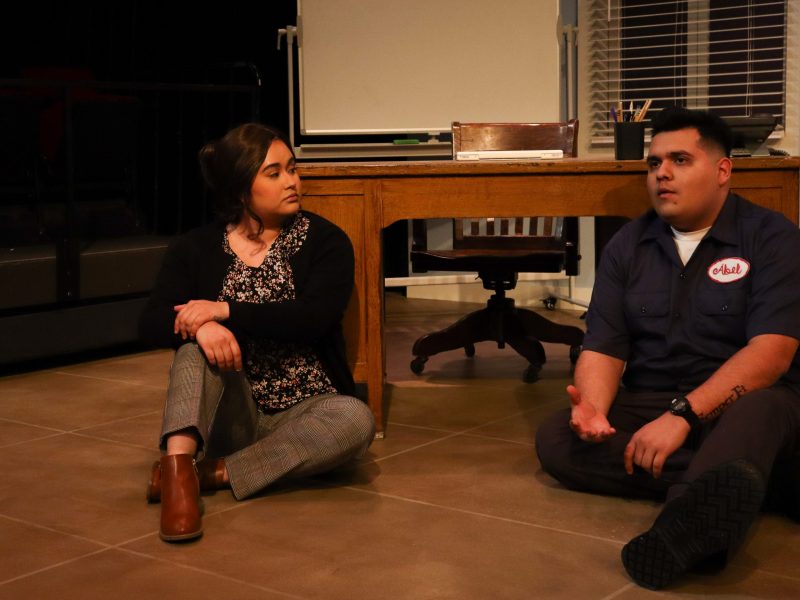
 I wasn’t sure what to expect going into a play about two FBI agents on a stakeout…watching two other agents on a stakeout. It sounds almost too simple. But what unfolds is funny, tense, and surprisingly emotional in a way that really sneaks up on you.
Martin Dockery has a way of telling a story that feels effortless. The dialogue is sharp and quick, and the humor feels natural, not forced. One minute you’re laughing at the back-and-forth between the agents, and the next you’re completely pulled into something much deeper. The stakeout becomes more than just a setup, it turns into a space where bigger questions come out, especially about fathers and sons.
What really stands out is how relatable it feels. Beneath the jokes and tension, there’s this honest look at expectations, disappointment, admiration, and the complicated love between parents and children. It doesn’t hit you over the head with emotion it just sort of builds quietly until you realize you care a lot about what these characters are going through.
The pacing keeps you locked in the whole time. It’s intense but never overwhelming, and the balance between comedy and heartfelt moments feels just right. You can see why it’s earned so much praise at festivals. It feels polished, but still personal.
By the end, it’s not really about FBI agents at all. It’s about perspective, about how we see the people closest to us, and how we want them to see us. It’s funny, a little heartbreaking, and very human.

If you get the chance to see it, it’s definitely worth it. It’s one of those shows that stays with you after you leave. There is one more performance.
— Hailey Milasich
“The Fugue,” Kate McKnight
Venue: VISTA Theatre
Kate McNight’s “The Fugue” weaves autobiography and music together in an interesting way. In McKnight’s childhood, piano lessons and the classical canon made a big impact on her. So did the classic rock her parents listened to, and, as she grew into adulthood, her own musical tastes developed. These tunes form a soundtrack for McKnight’s collection of musings and monologues, and in an impactful touch, she performs some original music live on a keyboard.
There is promise in the premise, although this show felt a bit underprepared and wandering at the first-weekend performance I attended. The opening minutes seemed to crawl. I would have liked to see McKnight get out from behind her music stand and written script. When the storyline gets specific — she recounts at age 14 how she didn’t get the school-play role of Emily in “Our Town,” much to her irritation — the emotional appeal increases. For me, one of the strongest moments of the show is when she acknowledges the patience (and occasional exasperation) of her longtime music teacher. “Did I ever thank you, Mrs. Mathers?” she asks.
When she shifts to other moments, like in the dissolution of relationships, things feel less specific and more abstract. We lose the emotional through-line. And the musical juxtapositions become less effective. Overall, there is a depth of tenderness and introspection in “The Fugue,” and with more development, I see some real promise. One performance remains.
— Donald Munro
“Wikipedia Love,” Noam Osband
Venue: Hart’s Haven
 So. Many. Questions. If you lived in the town of Dildo, would you vote to change the name? Can you call a penguin a prostitute if no legal tender is exchanged prior to a prearranged sexual transaction? If you are part of a Norwegian environmental activist group called Fuck for Forest that makes porn and donates the profits to planting trees, would your condoms be tax deductible?
But the most intriguing question in Rogue performer Noam Osband’s amusing show, titled “Wikipedilove,” is this: How did an Ivy League anthropology professor end up in a tent behind a bookstore singing songs about promiscuous gray whales?
The common thread, which Osband cheerfully pounds to death in an opening song, is weird stuff about sex and love on Wikipedia. One of the most endearing aspects of the show is Osband’s rabbit-hole approach to his narrative meanderings, which is how we somehow end up on an extended riff about Eva Braun’s wedding certificate. It’s weird but funny.
The musical part of the show never gets past sing-song lyrics with basic chords, but you aren’t going to a show like this to hear numbers by Jason Robert Brown. Osband is a vigorous performer, and when I say that he brays his songs rather than sings, I’m guessing he’d proudly agree. The delivery is part of the shtick. At the first-weekend performance I saw, by 10 minutes into the show he’d completely sweated through his shirt. He burned calories so we could laugh.
As for those laughs, they’re mostly bawdy, silly and strange. It goes to show that Wikipedia distills almost all of humanity’s knowledge, not just the serious stuff. Just ask the guy who earned degrees at Harvard and Oxford. He gets a chuckle out of dinosaur erotica.
— Donald Munro