




In these ‘Woods,’ a teacher ponders a mighty truth: Children do listen
In Stephen Sondheim’s brilliant “Into the Woods,” whose lyrics are among the most sophisticated and insightful ever written for musical theater, the song “Children Will Listen” has always been special to me. Hearing it can make me pensive, but I also spend some time in wonderment at how insightful the words can be. What’s more, I love talking about the song with someone else who appreciates its power.
So I asked Sara Price, who plays the Witch in the new Good Company Players production (now in its opening weekend), to have a chat about “Children Will Listen,” which her character sings. Her insights on the song, and about the show — and regarding life in general! — are pretty special. I loved putting together this piece.
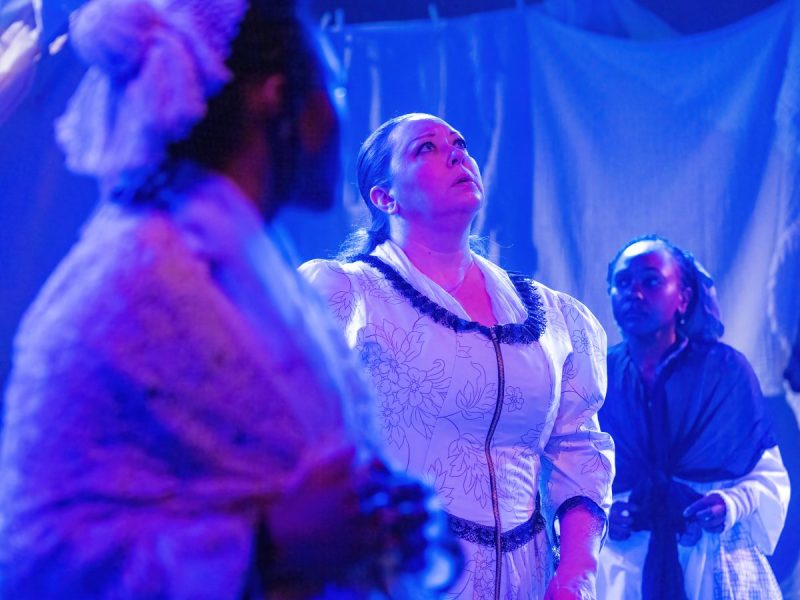
Sara Price, right, plays the Witch in “Into the Woods.” Also pictured: Teddy Maldonado, left, and Emily Pessano. Photo / Good Company Players
Donald: The lyrics sometimes creep up on me unexpectedly, which I think is a sign that they’ve really burrowed their way into my brain. Do you remember the first time you heard “Children Will Listen”? What was your reaction?
Sara: I first heard the song when I was in college. I was watching the recorded Broadway version of the play starring Bernadette Peters, and that was the song I walked away from that first listen saying, “Well, that’s the point, isn’t it!” It seemed to perfectly encapsulate the underlying truth of the musical— and the truth of stories in general. I don’t know that I understood all that then, but it’s now real to me on a lived-in level.
Donald: For those who aren’t familiar with the lyrics, here’s the first stanza of the song:
STORY CONTINUES AFTER SPONSORED CONTENT


Careful the things you say
Children will listen
Careful the things you do
Children will see
And learn
Children may not obey
But children will listen
Children will look to you
For which way to turn
To learn what to be
Careful before you say
“Listen to me”
Children will listen
You are an English teacher, and hundreds — thousands? — of children have listened to you over the years. Are you conscious of the kind of impact you can have? Or does it just become second-nature?
Sara: It’s a truly weighty thing, this whole teacher role. You stand up in front of children all day, and they trust that all you say is gospel truth. I try to teach them to question everything — even me — but that kind of critical thinking doesn’t come easily to any of us. Every teacher I know is sobered by their potential effect on the future of the humankind. I know I am! I prayed and agonized over which literature I chose to teach when I first began teaching 12 years ago. I knew I only had so much time to affect their hearts, and the possibilities were endless. I didn’t want to waste my moment with them. And it really feels like just a moment that you have them. Far too much you wish to impart, and far too little time in which to do it.
I also worried about teaching them to see the world too clearly. There’s always the chance that they might find something in it you wish they hadn’t. That’s freedom of thought. It’s always a risk, isn’t it? Freedom is inherently risky. Of course, as a teacher, you have such power to frame how they read these truly brilliant works; however, great art has a mind of its own and quickly begins to inspire more than any one person could imagine. Shakespeare, Dickinson, Frost, Bradbury, Bronte, Austen, Hardy … these are pretty great partners to have in the business of teaching. If I thought I had to rely only on my own brilliance (or lack thereof) to impart wisdom, I’d be a pretty miserable teacher.
Donald: There’s an interesting connection between the idea of making art and having an impact on children. With both, you don’t always have control over the “final product,” you might say. What are your thoughts?
Sara: That’s exactly it! You have no control — nor would I want to! — over what children think or who they become. The truly great teachers know that success isn’t churning out automatons who parrot back all you said. You can do your best to teach them how to think, how to question, how to rationalize. But you cannot control what they do with that. At some point, you release them into the world at large and hope that good comes from it. It’s always an exercise in faith.
Donald: Can you think of a time when you had an impact on a child and didn’t realize it until later?
Sara: It happens all the time, in both positive and negative ways. Many is the time I have said something out of impatience (or just my natural tendency towards snark) that has come back to bite me. Some statement I threw out lightly only to find out later that it had hit the kid over the head like a lead ton. I’m haunted by those moments. Luckily, there are more of the other kind of stories. I keep in pretty good touch with my former students, and they often remember in minute detail things I’ve said and done with them that they tell me really affected who they became. Those are the moments you gather close to your heart and hold up as a buffer for the days when you’re exhausted and feeling like nothing you’re saying is getting any traction.
Donald: You play the Witch in “Into the Woods.” The lyrics to “Children Will Listen,” which come late in the show, actually mirror back to earlier lyrics in which your character proclaims, “Children won’t listen.” Tell us about this evolution.
Sara: The Witch is a character from the Rapunzel tale. In one of the musical’s heavier moments, the Witch is forced to face the fact that— for all her attempts at control and keeping Rapunzel safely locked away in a tower— she has lost her. The number is aptly titled “Witch’s Lament” because it’s her moment of dealing with the pain of that loss. The director, Julie Lucido, had a very clear take on the character before rehearsals even began, and she shared it with me. She saw the witch as being tormented by her own mother’s flaws and failures and being motivated by her desire not to make the same mistakes. That moment in the song when the Witch says, “No matter what you say, children won’t listen” is just as much as her own self-accusation as it is directed at Rapunzel. She is realizing that she didn’t listen and didn’t learn and is now wracked with pain because of it. It’s a bitter realization because she’s seeing that loving something brings pain, so she’s interpreting that pain as a curse.
 Good Company Players
 By the end of the show, however, she sings the song again with the change in lyrics that one should be careful of what they say because children are actually always listening and learning from us. It comes on the heels of “No One Is Alone,” and ends the show with the reminder that love is not a curse, but it does cost. But children are no less a blessing for all that. Like everything truly powerful and wonderful in life, one should take care with it. Think long and hard before you ask a child to listen to you. It’s an awesome responsibility, and one that should never be taken lightly.
Donald: The show is a clever mash-up of fairy tales, but this is no “Shrek” — it isn’t all for comic effect. There’s a darker side to the show. In a Disneyfied world, a lot of people forget that fairy tales can be very dark, too. Do you think there’s a tendency today to “shield” children from stories that are rough or challenging? If so, what kind of impact could it have on their development?
Sara: I see it as a major problem in our modern world. We constantly edit out anything from stories, fairy tales and poems that could possibly challenge or scare or make uncomfortable our children. We’ve effectively neutered our fairy tales beyond recognition from their earlier versions. We don’t want to unnecessarily worry our children, so we edit out the wolf actually eating up Little Red Riding Hood. We don’t want to scare them, so we omit the ending to “Hansel and Gretel” where the witch is thrown into the oven. We don’t want to be too morbid, so we leave out the part where the ugly stepsisters mutilate their feet to fit the golden slipper in Cinderella.
he problem is that the reason these tales have endured throughout so many cultures and for thousands of years is because they reflect some underlying truth about the nature of man. They echo reality. Taking away the parts that trouble us cheats the tales out of being the conduits for self-discovery. Why do we use Story? Why do we tell these tales? It’s a way for us to obliquely study ourselves. To know what otherwise cannot be known. The great tales rightly reflect the moral narrative of our universe. Yes, evil exists. But it meets a hard and gruesome end. The witch in “Hansel and Gretel” gets cooked. That might seem like an overly harsh judgment to read to a child. But for the kid, it’s a justice which assures them far more that our shallow safe stories ever can. They might never meet a witch who wants to eat them, but most children have met or known of an adult who wanted to hurt children. Many kids are abused by their parents.
Knowing that justice will be served is a comforting thing, not a scary one. So many parents think they’re shielding their children by not reading or talking about these things with them, only to find that they are crippling their kids when it comes to dealing with life.
Less importantly, but no less true, humans are drawn to violence and salaciousness. If we cut it out of our good tales, children will find that elsewhere. It’s a little like denying your children fruit because of the sugars in it. They’ll find other sugars to consume which provide far less else of nutritional value. And we see this all the time with the rise of gratuitous violence in video games and action films. They’re consuming that violence through means which provide nothing else of worth for their development.
Donald: The “Woods” in the show are a metaphor. What do the Woods mean to you personally? If I’d asked you this question 15 years ago, say, would your answer have been different?
Sara: I can’t turn off my English teacher’s brain for this one. My ready answer is that the woods are a metaphor for the wild, the unknown, that which is not yet tamed by human laws. It’s why these same woods find themselves in so many stories and poems and fairy tales. It’s always that moment when the character is faced with a journey that defies charts and clear paths. It’s why Ichabod is only safe when he crosses the bridge leading away from the woods and back into civilization. It’s why Little Red Riding Hood is warned not to stray from the path. It’s why the speaker in Frost’s poem shocks the reader by describing those same woods as “lovely, dark, and deep.”
With that understanding, what isn’t the woods about my life? We humans have such a limited view of reality. We see only what’s directly in front of us, and even that we misinterpret all too often. We can’t even trust our memories, as we tend to omit some details while others are highlighted far beyond their actual import. For all our planning and scheduling and attempts at control, life has a way of knocking us upside the head and reminding us how little actual control we have.
I think 15 years ago I might’ve answered with something about the future. I knew enough to know that “the best laid plans of mice and men often go awry.” But I think I underestimated the dark complexity of the present and the past. In short, it’s all woods to me.
Donald: There’s another song in the show, “No One Is Alone” that always gets me as well. The line goes, “Sometimes people leave you halfway through the wood.” What does that mean to you?
Sara: I think you can take this line very literally in as much as no one stays with us forever. Death is a part of living, and along with death comes loss. Perhaps you lose the one person who made this whole journey through life seem safe or possible. Without them, you’re faced with the terror of having to figure out how to keep walking, how to make decisions, how to go on alone. These are the darkest moments in our journey, but my hope is found in the next line of the song. “Do not let it grieve you…no one leaves for good.”
Donald: Another open-ended question: At one point in the show, Little Red says, “I wish.” And Cinderella says, “I know.” What do you think she wishes for?
Sara: I think Little Red, like we all do at one point in our lives, finds herself at the moment when a wish or desire is fulfilled, realizing that the fulfillment of that wish has created a world she no longer knows. Perhaps she’s not even sure how to exist in it. She wishes for the before because at least that was known. In the story of Exodus, the Israelites spent a good deal of their wandering through the desert whining about how much better it was when they were enslaved in Egypt. I think we all have a tendency to paint over our pasts with a dreamy hue, not even realizing we are being sentimental about times which were sometimes hard and had their fair share of pains. We long for the known even when it’s less than what’s before us. It’s why we avoid the “woods” to the point of cheating ourselves out of progress, adventure, and self-discovery.
Donald: Anything else you’d like to say?
Sara: I think I’ve talked more than enough, so I’d like to close with a quote by one of my favorite authors:
“When I was 10, I read fairy tales in secret and would have been ashamed if I had been found doing so. Now that I am 50, I read them openly. When I became a man I put away childish things, including the fear of childishness and the desire to be very grown up.”
― C.S. Lewis
Show info
‘Into the Woods,’ a Good Company Players production at Roger Rocka’s Dinner Theatre. Continues through Sept. 16. Tickets (some including dessert or dinner) are $32-$60.

Judy Shehadey
Sara Price piece: very interesting, very special. Intelligent, insightful. A joy to read. Thank you.
Judy Shehadey