



Review: Near/Far Theatre makes a solid debut with ‘The Sins of Sor Juana’
THEATER REVIEW
It’s always a treat to welcome a new theater company to the table. Near/Far Theatre, a collaborative group spearheaded by former Fresno Pacific University theater program director Julia Reimer, makes its debut with a thoughtful production of “The Sins of Sor Juana.” It continues for three more performances ). Here’s a rundown:
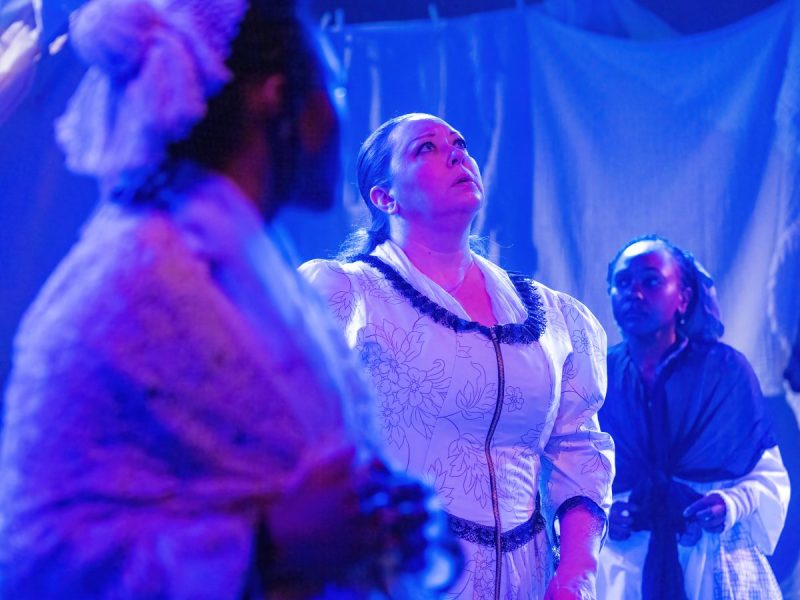
Pictured above: Maria Monreal and Edgar Olivera in ‘The Sins of Sor Juana.’ Photo: Near/Far Theatre
The title character: Juana Inés de la Cruz, who lived from 1648-95, is one of the best known women in early Mexican history. She was an early intellectual prodigy and by age 17 had, with her intellectual prowess, wowed the colonial viceroy’s court in Mexico City, where she served as a lady-in-waiting. She is known for her work as a philosopher, composer and poet. By age 19, she left court to join a monastery, where she remained cloistered until her death.
The play: “The Sins of Sor Juana” focuses on two major experiences of Juana’s life: her time at the colonial viceroy’s court; and her time at the Convent of Santa Paula of the Hieronymite. Playwright Karen Zacarias, whose “Just Like Us” was performed at Fresno State last year, imagines what happened in those settings. The action shifts from later in Juana’s life at the monastery, where she has run into trouble because of her published writings, to flashbacks of life at court. While the subject matter is mostly somber, Zacarias brings flashes of wit and some bite to the proceedings. In a later time, Juana would have been recognized as an intellectual genius and allowed to blossom to her full potential. But her gender and the stultifying religious atmosphere of the time forced her into a much smaller life.
The Munro Review has no paywall but is financially supported by readers who believe in its non-profit mission of bringing professional arts journalism to the central San Joaquin Valley. You can help by signing up for a monthly recurring paid membership or make a one-time donation of as little as $3. All memberships and donations are tax-deductible.
The production: Reimer, the director, uses the parish hall of Willow Mennonite Church to sophisticated advantage. The scenic design is minimalist, but as the action toggles between court and the monastery, Kiki Reza’s sumptuous period costume design and Broderic Beard’s lighting design engages the audience, particularly in such an intimate setting. (The moment when Juana peels off her nun’s habit to reveal an aristocratic dress is a highlight). Characters enter the space in intriguing ways, and even the simple inching downward of tapestry-like set dressings over the stage walls — something obviously being done by an actor standing behind — has an impact greater than you’d expect from such a low-tech endeavor. The direction is tight and thoughtful, and while the narrative itself is sometimes hard to follow, I thought that each character rang true.
STORY CONTINUES AFTER SPONSORED CONTENT


Daniel Longoria
The acting: Karen Vargas ably carries the show as Juana, though I found myself more drawn to her scenes at the convent compared to the court. (I think the writing has something to do with that.) Daniel Serrano, as the man goaded into pursuing her, is compellingly rakish. Maria Monreal is a standout in a dual role as a snippy nun and the viceroy’s overly infatuated wife. Marrissa Lopez has a feisty spirit as Xochitl, the indigenous maid. Viri Hussain-León, Edgar Olivera and Daniel Longoria round out a fine ensemble cast. (Longoria’s puppyish longing for Juana is a welcome comic distraction.)
The music: EJ Hinojosa composed the atmospheric original music for the production, a luxurious touch.
My takeaway: This wasn’t my only recent encounter with Juana Inés de la Cruz. I recently wrote an article for the Los Angeles Chamber Orchestra program book about composer Juan Pablo Contrearas (who, incidentally, has written an upcoming commissioned piece for the Youth Orchestras of Fresno). A section of Contreras’ “Musas Mexicanas” is devoted to de la Cruz, and as I researched my piece, I came away with a much different impression of her than the play presents. That isn’t necessarily a bad thing; this is a work of fiction, and Zacarías used her subject’s life as a framework upon which to project her own explorations and themes. But, I chafed just a little at the playwright’s insistence on making sexual conquest and potential illicit romance such a major part of the court storyline. It just seemed to somehow slightly cheapen the process. Just about every tale that we tell has to throw in a romantic angle. In de la Cruz’s case, why not make it about someone smitten with words? That would be a pretty amazing love story all its own.
Show info
‘The Sins of Sor Juana,’ 8 p.m. Friday, May 10, and Saturday, May 11; and 7:30 p.m. Sunday, May 12 Willow Avenue Mennonite Church, 2529 Willow Ave., Clovis. Tickets are $15 general, 412 students with I.D.