
Theater review: In the upbeat math of ‘SIX,’ it takes 2 critics to dissect this glitzy, engaging musical
Editor’s note: Donald Munro and Heather Parish are usually found at separate theatrical events, not the same one. But the musical “SIX” brought them together for Fresno’s biggest professional theatrical event of the season. Here is their take on the Broadway in Fresno national tour.
DONALD: Good morning, Heather, and happy “SIX” week to you. I don’t know if you noticed at last night’s opening, but I wore my flashiest sports coat (shades of burgundy with tiny bluish gold stripes) in honor of the Queens. I don’t think I could match the dazzle of, say, Catherine of Aragon’s glorious gold wedding-gown-meets-glam-punk costume, but it put me in the right mood. How about you? As the show opened, did you feel any majesty in the presence of these six characters?
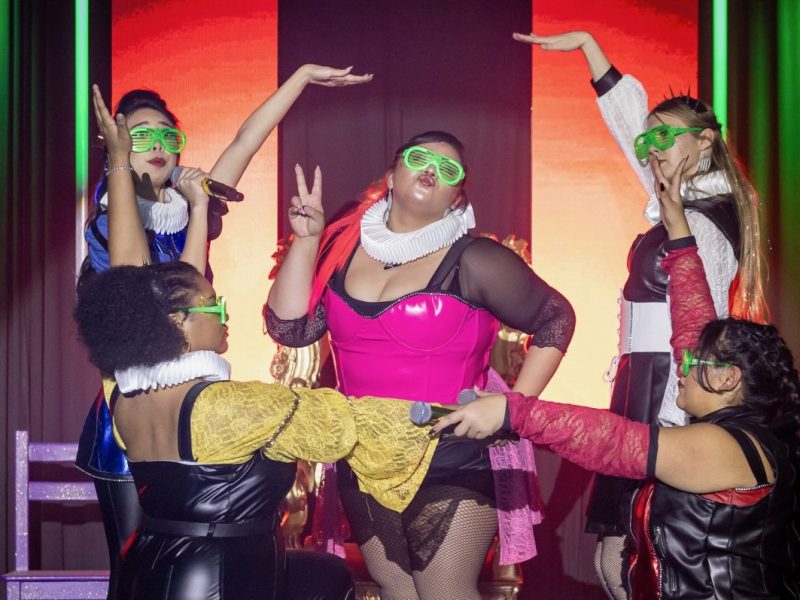
Pictured above: Gaby Albo as Anne Boleyn (center) in The North American Tour of “SIX.” Photo by Joan Marcus.
HEATHER: I did, in fact, notice that you looked a bit snazzier than usual last night. I couldn’t even attempt to reflect the majesty of the SIX queens, so overwhelming were they from their first moment on the stage. From the initial flash of the lights I felt like I was in an arena seeing pop-goddesses like Ariana Grande or P!nk rather than the Saroyan Theater. What were your first reactions?
DONALD: I think it’s a slick, fun, LOUD show. I enjoyed it, but I didn’t love it the way I did when I saw it on Broadway. There it is in a much smaller theater than the Saroyan, and I had a stronger emotional connection. Then again, a second viewing of a production — even one I liked a lot — can be tougher, of course. Plus, I freely admit to being caught up in the pre-Tony Award “SIX” hype in New York; I nabbed a seat in the sold-out theater just 10 minutes before curtain after standing in line for an hour. So I already had adrenaline pumping through me. I’m curious about your reaction on a couple of levels: I know that you aren’t always as swayed by Broadway glitz and glamour as me; and you’re also strongly steeped in the Henry VIII era and know a lot more about his wives than the vast majority of the audience. Did you find yourself falling under the “SIX” spell even though Anna of Cleves probably wouldn’t have ever considered stripping down to her underthings in front of a few thousand people?
HEATHER: When SIX first hit in London a few years back, of course I heard about it. It was the talk of the Renaissance Faire community (in which I spent over a decade performing and producing). But as you say, I’m not often swayed by theatrical buzz and I can’t say as I was hotly interested in SIX’s concept. Because I am so familiar with the queens’ essential biographies, I was skeptical about how well their characters translate into the modern shorthand of musical theater – especially a pop musical presented like a Eurovision competition. But I walked into this, as I often do with new musicals, with mostly fresh eyes. I was pleasantly surprised — in fact I haven’t smiled so much throughout a show in some time! I liked most of the music, even though I’m not a big modern pop fan, and the queens had a lot of really fun, funky characterization that (mostly) captured the core of their personas in the Tudor era. I had a few qualms about how they would be portrayed, but most of them were addressed pretty well. It isn’t “Wolf Hall,” but it has its place and is enjoyable as a light, entertainment that reframes the stereotypes of these historic women. For that, I give it due respect.


DONALD: My favorite queenly moment in the spotlight is Katherine Howard, Henry’s fifth wife and the second to be beheaded. (One of the show’s most amusing comic throughlines is the decapitation rivalry between Katherine and Anne Boleyn.) Alize Cruz plays Katherine with a feline-smooth, sex-kitten purr, but there’s also a lot of pain there as well. Her song “All You Wanna Do” is a slow-boil desperation about the objectification of women. Because of her beauty, Katherine was put on a childhood track to be sexually desired and was never able to get off it. To me, the song is the deepest lament of the show. It’s also the point in which the vigorous pop-style choreography reaches its zenith, with the other queens dangling and thrusting their arms like zombies as Katherine tires of incessant human contact. Heather, I want to ask you two questions: In terms of the historical record, do you have a “favorite queen”? And if you do, is that answer different from your favorite performance in the show?
HEATHER: I got the biggest kick out of “Haus of Holbein,” the ensemble German-techno number with its ironic lyrics and quirky choreography. I agree, though, that Cruz’ performance of “All You Wanna Do,” was my favorite solo. It wasn’t necessarily my favorite song in the show, though (that is Anna of Cleves’ funky “Get Down,” performed by Danielle Mendoza). I had feared “All You Wanna Do” was going to be the common portrayal of Howard as an oversexed dumb-bell, but it took that darker turn, acknowledging that Howard was likely groomed and by her uncle, the powerful Duke of Norfolk, and was trained to use sex to survive. Until she didn’t. I can go on and on about the merits and demerits of each Tudor Queen (including Henry’s two daughters, Mary and Elizabeth), but my heart belongs to the queens who used their wits to advantage. Jane Seymour could have been the true making of Henry VIII, if hemorrhage hadn’t taken her after childbirth. Catherine Parr was a pragmatic intellectual who knew how to manage a precarious life at court, and Anna of Cleves – as the show rightly points out – got the best severance (no pun intended) package of all of them. Considering history probably lied about Henry’s rejection of her for 500 years, I can’t begrudge her making the most of her lot. In terms of overall performance, I think Tasia Jungbauer held both the historical Catherine Parr and the stage Catherine Parr in the best balance. I cannot fault her “I Don’t Need Your Love” as a feminist power anthem. Do you have any questions about SIX, Donald? Theatrically or historically? What makes sense and what doesn’t?
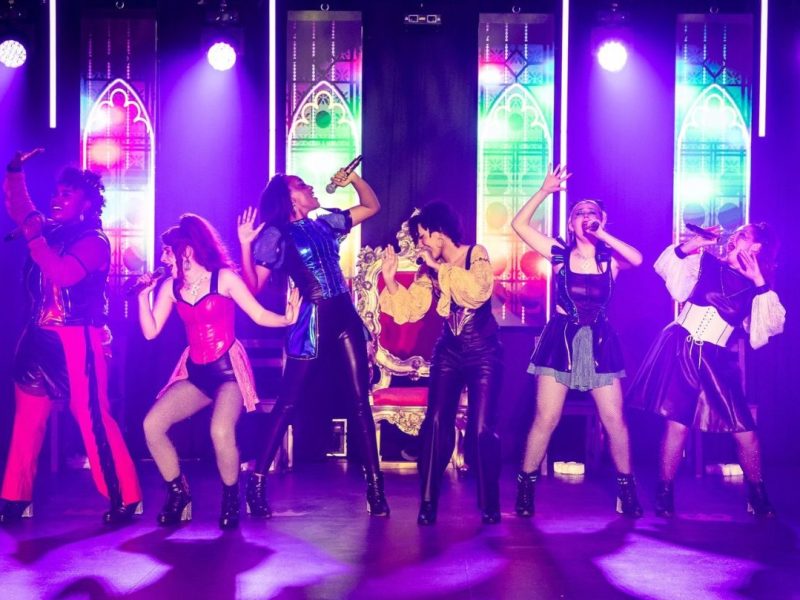
DONALD: My favorite lyric is when Anna sings “Dance so hard that I’m causin’ a sensation / Okay ladies, let’s get in reformation!” Thinking back on my upbringing, I realize that what I took away most from the Henry VIII story is how he split the Catholic Church and changed the world. (My dad was a Presbyterian minister, so you can see how I absorbed the Calvinist vibe on this one.) Historically, did Henry really rip apart a 1,500-year-old Church just for lust, or was it more complicated than that? And, theatrically, I’m wondering what you think of the structural gimmick on which the show is based — that the queens are all competing to see which one got the rawest deal from His Royal Majesty. Without giving too much away, there’s an alteration to that premise made late in the show. Did you feel at all that the writing there was a little cheap, or maybe desperate? I think I do. Finally, and I want to give you the last word, I do want to ask you about the costumes, because they are, without a doubt, a highlight of the show, along with the lighting design. I felt like there was something architectural about them, as if they were deconstructing stained glass, turrets and big, strutting gowns. Your final thoughts?
The Munro Review has no paywall but is financially supported by readers who believe in its non-profit mission of bringing professional arts journalism to the central San Joaquin Valley. You can help by signing up for a monthly recurring paid membership or make a one-time donation of as little as $3. All memberships and donations are tax-deductible. The Munro Review is funded in part by the City of Fresno Measure P Expanded Access to Arts and Culture Fund administered by the Fresno Arts Council.
HEATHER: So many questions! I like your thought about the costumes being architectural. They definitely give the impression of the queens being encased in their roles. And while they are futuristic and funky, they also feature elements of the historical garb of the 16th century. I recognized so many details used in costumes I’ve created and worn as an historical re-enactor. As someone familiar with the era, I enjoyed being able to spot those details in the costumes, lyrics, and dialogue. That gives the show a little more satisfaction to someone familiar with the Tudor era.
And yes, Henry VIII breaking from Rome was more complicated than just “lust,” and as far as I can tell, he tried everything he could before resorting to schism. However, the lack of a male heir and a wife beyond childbearing years created an opening for an ambitious, strategic-thinking family like the Boleyns. Anne was savvy and knew how to work the system both politically and personally, something not shown in “SIX.” She was a great campaigner but lousy at the job once she got into office. “It’s complicated” barely scratches the surface!
And I’m glad you brought up some of the questions regarding the conceit of the show. Considering its origins in fringe theater, I didn’t expect a compelling dramatic question here. I feel that the writing succeeded in giving these historical women a chance to speak for themselves and didn’t shy away from the trauma and abuse they experienced. But that last-minute change at “I Don’t Need Your Love” certainly feels like an unearned 180. Even if we take each woman on her own terms, her story will still be seen in light of “His Majesty” because of the realities of her time.
Ultimately, though, a musical like “SIX” can spark interest in historical figures and start important conversations about gender, power, and historical narratives. What it can’t provide is a nuanced exploration of these topics. That’s not its job. What “SIX” does best is prioritize entertainment and emotional engagement through powerful vocals and imagery for an audience of young women who will hopefully continue the conversation about women, history, and what they have to offer the world in the future.
“SIX” continues at the Saroyan Theater through Sunday, April 6. Note: A limited number of rush tickets are available 90 minutes prior to each performance at the Box Office. Limited to 2 tickets per ID, in person only.