
THEATER REVIEW: Selma’s energetic ‘RENT’ balances nostalgia with now
By Heather Parish
I was 23 years old in 1996 when “RENT” debuted on Broadway, around the same age as many of the characters in the show. I was working on a theater internship in London when it hit and the original Broadway cast recording was released. Its tentacles rapidly crossed the Atlantic and into the rehearsal spaces and greenrooms I was in and out of all spring and summer. By the time I got back stateside, it was everywhere.
Life Support Group Chat
The show’s composer, Jonathan Larson, stated that he wanted to make a rock musical “for the MTV generation.” Drugs, AIDS, poverty, squalor, life on the razor’s edge of survival. Sounds like a fun night at the theater. But three decades later the musical has become an icon of the 1990s zeitgeist, blending the inspiration and cynicism of Generation X as it moved through that liminal space between the 80s and the new millennium. “RENT’s” ubiquitousness at all levels of theater can be a head-scratcher for those of us who have watched it from the beginning. With every new production, we tend to ask a lot of questions, like: “Rent? Again?” “It’s kind of dated, right?” “Did we really need a teen version of that?” “Is the rock musical still a thing? Is rock music still a thing?” “Do artists still squat in the East Village?” “Are artists still artists? Or are they all influencers now?”
Related story: As Selma Arts Center opens ‘RENT,’ a new generation will experience a story rooted in the ’90s. Is it still relevant?
In the words of “RENT’s” antagonist, Benny, “Bohemia is a fallacy in your head. This is Calcutta. Bohemia is dead.”
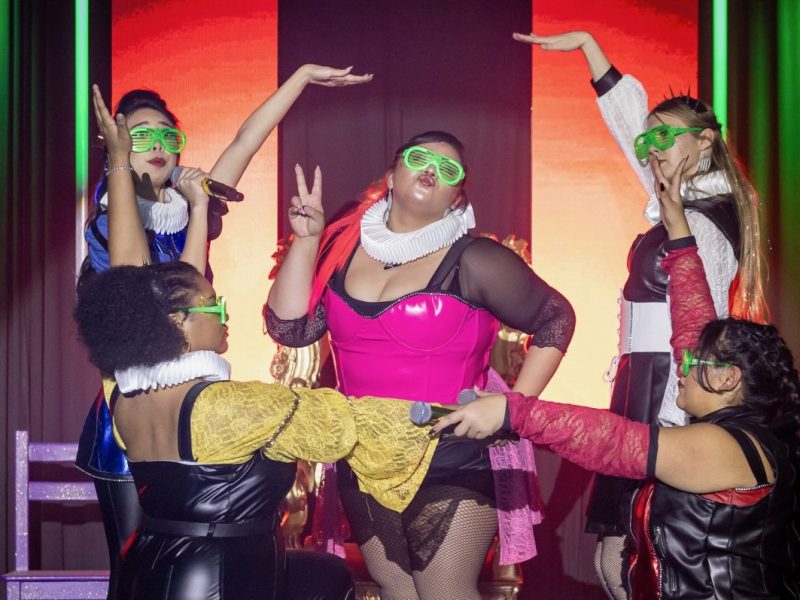
So, despite my own Gen X jadedness, I was surprised and delighted by Selma Arts Center’s production of “RENT,” directed by Michael C. Flores. Here the material feels new, even when delivered through a nostalgic lens. Full of exuberant staging and exultant performances, this iteration captures much of the fresh energy of “RENT” while acknowledging it as something of a period piece. It is an approach that works.
Main character energy
“RENT” is a classic Orpheus Descending tale, following a group of friends trying to make it through life, love, and art in New York City’s gritty East Village during the late ’80s and early ’90s. Narrator Mark (an endearing Gavin Flores) is an aspiring filmmaker, and his roommate Roger (Jack Hammerstrom, prickly and passionate) is a musician still mourning his girlfriend’s death. Their neighbor Mimi (a vulnerable Annelise Escobedo), a dancer battling addiction, sparks something electric in Roger. Their friend Collins (a strong Gabe Facio on opening weekend) falls for Angel (an ebullient Damen Pardo), a vibrant drag performer, and the two share one of the show’s most heartfelt relationships. Meanwhile, Mark’s ex, Maureen (Willow Rogers, giving young Catherine O’Hara comedic vibes) is a bold performance artist now dating Joanne (a focused Jessica Ellesse Meredith), a sharp and no-nonsense lawyer. Throughout the story, this tight-knit group clashes with Benny (a solid Adam Chavez), their former roommate turned landlord, who’s threatening to evict them. Over the course of a year, they face loss, illness, passion, and some tough choices about how to survive while holding onto their creative integrity.
The ensemble moves well as a whole and offers some moments for talented soloists to shine through. The show is almost entirely sung-through, and stand out ensemble numbers include the opener “Rent,” and Act I finale, “La Vie Bohème,” which bursts with rebellious spirit.


“Seasons of Love” is the show’s most iconic song — an anthem that features two exceptional soloists (Noah Villaverde and Deyzha Gonzales)—and sets the tone for the second act. However, duets loom large in “RENT.” Escobedo and Hammerstrom blend their two divergent vocal styles into some of the most crackling drama in “Light My Candle,” “Another Day,” and “Without You.” Meredith and Rogers deliver opposites attract chemistry on “Take Me As I Am,” while in “I’ll Cover You” Facio and Pardo deliver some of the show’s most touching and heartbreaking moments. My favorite duet of the show, however, is actually “What You Own,” delivered powerfully by Flores and Hammerstrom, illuminating Mark and Roger’s vital connection and the importance of friendship to shape the values of an artistic life.
Seasons of Docs (Martens)
Director Flores uses every bit of the space to bring the performances closer to the audience. There are a number of playing spaces to shift through, and Flores does an admirable job keeping things hopping. Nicolette Andersen’s scenic design extends the set into the wings and into the audience, exposing the grit and slapdash living conditions of the building. The lighting design by Vinny Galindo is moody and effective, giving the darkly cold mood of an NYC winter. Costumes by Javier Puga Jr. are nearly spot on for the period, with the only head-scratcher being Benny’s hip, downtown fashion rather than the ill-fitting suit of a guy who married into the family real estate business. I do give credit, though, for the sheer number of Doc Martens tromping across the stage. All in all, the aesthetics are spot on.
TikTok would eat this up
Two directorial choices help this production rise above the many productions of “RENT” I’ve seen over the years. First, the choreography (also by director Flores) flows throughout the action, providing a connective tissue to each moment. Some of it is about the dancing, but most of it is more about the movement, the gestures, the placement on the stage, all of which communicates the subtext of the moment. It is very engaging.
The Munro Review has no paywall but is financially supported by readers who believe in its non-profit mission of bringing professional arts journalism to the central San Joaquin Valley. You can help by signing up for a monthly recurring paid membership or make a one-time donation of as little as $3. All memberships and donations are tax-deductible. The Munro Review is funded in part by the City of Fresno Measure P Expanded Access to Arts and Culture Fund administered by the Fresno Arts Council.
The second is Flores’ general approach to the material itself. Projected videos by Dylan Villanueva Hardcastle share narrator Marc’s view of his friends and their world. But it is more than a mere conceit. The videography is delivered in a style that has emotion and a sense of nostalgia behind it, as though Marc is not just filming his friends, but preserving a time that he knows will slip away some day.
Through this approach, Flores has set up a production that feels immediate in performance by a talented young cast, but also acknowledges that “RENT” is, in fact, a period piece. New generations discover their own parallels in “RENT” — coming of age, identity, integrity, creativity, connection — that are eternal. But so much of it is about holding on to a moment until that moment disappears, to be replaced by the next effervescent memory-yet-to-be.
“No day but today,” indeed.
“RENT” continues at Selma Arts Center through August 2nd.