




In search of the Rogue Festival Muse: ‘That which inspires.’
I
t had just rained in downtown Fresno—the kind of light, silvery rain that leaves the streets gleaming like wet slate. The drops clung to muraled brick walls and doorway awnings, and up above, corvids gathered on the telephone wires, their chatter echoing against the azure clouds drifting low over the rooftops of Downtown Fresno. ArtHop was in swing again: chatter spilling from gallery doors, neon reflections rippling in puddles, and strangers tilting their chins toward each other as they moved between shows.
In the midst of it all, I followed a band of merry rogues—production team members of the Rogue Festival, in fact—as they wound their way through the rain-slicked art walk in search of a muse. Not metaphorically, but a literal muse. The one that would become the visage of next year’s Rogue Festival.
Each autumn, the Rogue goes on a search for the one piece of visual art featured in the festival and crowns a new muse to embody its creative spirit. The image graces posters, t-shirts, and programs but also represents something deeper: the festival’s creative nerve.
Earlier in the evening, I sat down with Rogues Wendy Berry, Jeff Bittleston, and Jaguar Bennett to discuss the annual search for “The Muse.” The conversation drifted between philosophy and practicality—how to inspire without cliché, if it needs to look good on a t-shirt, and whether a muse has to be female to inspire. We talked about eras of Rogue muses past—the fire-breathing drag queen, the Madonna and child, and the wretched man in a box—and how each image reflected its moment in the festival’s restless evolution. (Full disclosure: I am a former executive producer of the Rogue Festival and chose the Muses from 2017, 2018, 2021, and 2022. Jaguar Bennett is also my husband.)
The following conversation (edited for length and clarity) is a glimpse into how Fresno’s most famously independent festival keeps chasing its inspiration, one muse at a time.


Heather Parish for The Munro Review:
Okay, y’all. . . so we’re gonna go muse shopping today, right?
All: Yeah.
Heather: First, what is the muse for the Rogue Festival to you?
Wendy Berry, president of the Rogue board of directors: To me, the muse is the face of the festival that brings the magical feelings and artistic inspiration behind it. I typically feel like it’s female because I’m very feminist, and this is a very female-forward festival—our executive producer, our president, most of our board is female. I love that most of our muses are female. It’s the inspiration that covers Fresno, the arts, and just inspiration in general. That’s what the muse is doing.
Jeff Bittleston, social media manager: Yeah, I think the muse is the visual representation of the soul of Rogue. The thing that we’re trying to put out there should be represented in this visual image—whatever that is.
Jaguar Bennett, former president and current secretary of the Rogue board: The muse has to be visually striking and unusual. The most crucial thing is that it cannot be merely decorative. It has to challenge the viewer—just like the Rogue Festival challenges the audience. Art should be disquieting. It should move you. We’re not looking for something that’s merely pretty or decorative.
Heather: What specifically are you looking for when scouting for the muse? What’s the criteria?
Wendy: For me, it’s a feeling. Any art that I love—when I look at it, it invokes some sort of emotion. When I see that, I get what’s in her eyes. I feel something from the picture. That’s what I’m looking for—that feeling.
Jeff: I agree with that. The muses I’ve been most attracted to have had an angst or longing to them. That inspires artists—that bit of dissatisfaction, a disappointment with the world, and wanting to make it better.
The muse from two years ago was perfect for that. Her face looked like she was distraught with what she was seeing. That’s the kind of thing I’m looking for.
Jaguar: Good art should have some element of dissatisfaction. It should move you. We’re not looking for art that’s just pretty to look at.
Heather: Would you say that’s always been the case?
Jaguar: Oh, no. We don’t always live up to it.
Heather: Yeah, there are distinct eras of the muse, if you look over the last 25 years, you’ve got the Marcel era, the Heather era, the Hogan era. Each one has its own look and feel.
[Marcel Nunis is the founder of the Rogue Festival and chose the first five muses. Barbara Coy-Hogan was executive director from 2015-2016.]
Heather: How would you define the current era of the muse?
Wendy Berry: What I’ve seen and what I want to see is real emotion, real women, real hair. I love muses that are women of color, natural hair, breastfeeding—anything real. Because Rogue is about stepping outside your comfort zone and getting into what’s real.
Jeff Bittleston: I’d like to see an element of hopefulness—that by expressing art, we can make the world better. There’s a tension between the world being kind of shit and wanting to make it better.
-

- 2006 Muse. Artist: Enrique Lopez
-

- Muse 2017. Photographer: Victor Trejo
-

- 2011 Muse. Artist: Reza Assemi
-

- 2017 Muse.Artist: Bryan Pickens
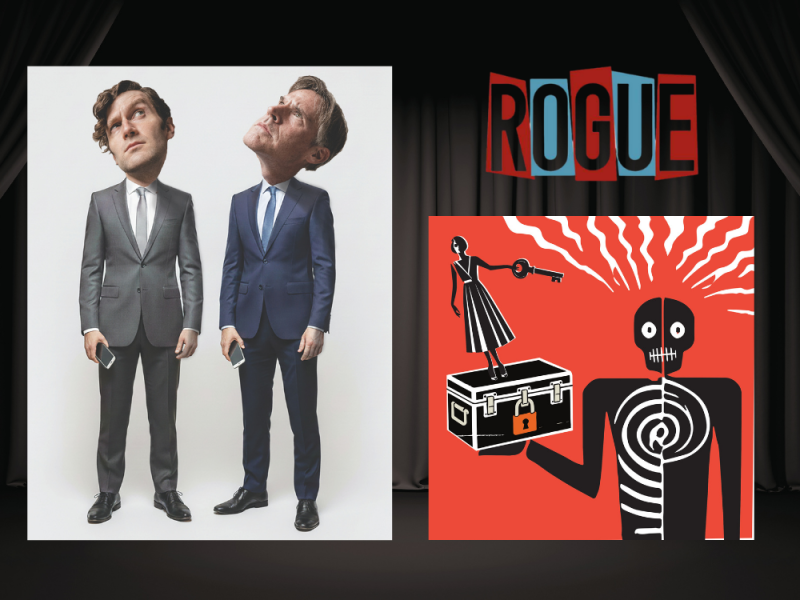
Heather: So, are you familiar with the muse from the 10th anniversary? It’s the one of the naked person in the box. It’s probably considered one of the darkest muses.
Jeff: I have probably seen it, but I don’t know what the 10th is.
Jaguar: It’s a man who looks like he is utterly naked and wretched. And trapped in a box.
Wendy Berry: Oh! That one. I don’t know if I’ve seen that.
Jaguar Bennett: (Shows the image on his phone). Yes, it’s a man who looks utterly naked and wretched, trapped in a box.
Jeff Bittleston: That one screams tension. It doesn’t scream hope, but it screams confinement.
Heather: It was a Jayne [Day] and Renee [Newlove] choice [former Rogue producers, 2007-2014]. But normally, the Jayne and Renee era is full of color and party, you know. It was very much the party era. And when we ask long-time attendees about their favorite muses, their favorites often come from that era. The most popular is the fire-breathing drag queen at Mardi Gras.
Jaguar: The most controversial one, though, was the “bondage” muse—wrapped in bandages, breasts exposed, blindfolded. People just weren’t comfortable with the image. It was never released. The official BS reason given was that “the muse has to have an eye.” There were “rules”—no nipples allowed, and the muse had to have an eye (shrugs).
Wendy Berry: Last year’s muse was all about nipples! We were determined to have nipples.
Heather: In the past, some eras have had requirements about nudity or kink. Others expected everything to be painted. But I did two that were digital art, which was newish at the time and then one was a photo.
Wendy: Was yours as the woman with the baby?
Heather: Yes.
Wendy: Oh, I love that one.
Heather: That was another one that a lot of people either loved or hated. But I wanted something in a different medium and to feature photography as an art form. So, are there any other limitations?
Wendy Berry: It has to be printable on a program and a T-shirt. Other than that, I don’t want to see violence or hate.
Jaguar Bennett: Well, that’s her opinion. It’s currently an artistic decision, but also a marketing one—it has to look good on a T-shirt. We do want something that catches the eye and sparks imagination.
Jeff Bittleston: And it can’t be boring.
Wendy: Yeah, absolutely.
Jaguar: True. That’s a good one. I think that’s the criteria. Not boring. And that is actually my complaint about previous muses. They were inoffensive. They were just dumb.
-

- Wendy Berry browses the prints at Dixie Salazar’s gallery.
-

- Jim Kitch contemplates a ladder’s “muse potential”
-

- Jaguar Bennet and Jeff Bittleston discuss the art at Fig Tree Gallery
-

- Artist Dixie Salazar shows Wendy Berry and Jeff Bittleston around her studio gallery.
Heather: Wendy, you mentioned about how the Rogue is very female-forward, and the muse is very representative of that. But there have been criticisms in the past… A, of oversexualizing women through the Muse, or B, using the female form for selling something. Thoughts?
Wendy Berry: I don’t find any of our muses overly sexualized. I don’t find the female breast or nipple overtly sexual. A nipple or breast is a sign of feeding a child, of giving life. We’re not showing genitals—we’re showing something natural. Men have nipples—why can’t we show ours?
Heather: I will clarify that most of those criticisms came before a nipple ever graced the cover of a program.
Jaguar: Well, we haven’t had an official vote of the board, but I’d venture to say that the Rogue is generally pro-nipple. And I will point out that the sexiest muse we ever had was the fire-breathing drag queen.
Heather: I was more given a pause by the idea of constantly using the female form as a piece of marketing. I feel like that’s about how it’s been approached a few times.
Jaguar: Well, you were talking about eras of the muse, and I think there was definitely a degenerate era of the muse, where everyone was simply like, ‘Here’s a white chick.’ And, yeah, I think that’s a fair criticism of that era. It’s just like, well, here’s a girl who’s got the outward markings of being pretty. And that’s all it is.
Heather: At times the muse has been chosen by a single person (the executive director). Other times there has been a “muse contest” and winner chosen by a panel. How is the muse chosen today?
Jaguar Bennett: We’re in the collectivist era now. It’s not one person’s vision anymore—it’s a team effort. We scout possibilities, and whatever we find tonight, we’ll take back to the whole production team. And we’re going to get different opinions. Now, I personally do not find the idea that a muse must be female a compelling question. I think, you know, the muse can be a collection of people. It can be a child. It can be a man. It can be an object. You know, the one definition that we have of the muse that we got from our founder is “the muse represents that which inspires.”
The muse represents that which inspires. It could be a person, a child, a man, an object—it doesn’t have to be female.
Wendy Berry: I love that. That’s as simple as it needs to be. What inspires me might not inspire you, but that’s the point.
Jaguar Bennett: I mean, when we try to set rules about the muse, you know, they have an eye, they’re the winner of a contest, or whatever. . . That’s what it’s going to crack when that which inspires you is such a prodigal idea. It has to be polymorphous. It has to be a free choice, because, you know, the muse that can be defined is not a muse.
Heather: How can artists get their work considered?
Wendy Berry: They can email us! I’d love that. It’s not a contest—just a way to get work in front of us for consideration. I would love to see what people have to offer.
Jeff Bittleston: “The hunt is on for the muse.” We’re out there looking, but if you want to be considered, send your work.
Jaguar Bennett: Yeah, Rogue always rewards initiative.
Heather: Anything else you’d like to add?
Jeff Bittleston: A good muse, right now, should have an element of resistance to the powers that be.
Jaguar Bennett: Yeah. I just want to see something cool.
To have your work considered for the Rogue Festival Muse, send your image or portfolio to the Rogue Festival production team at rogue.fresno.producers@gmail.com. The 2026 Rogue performer application window is also open until October 17 for independent performers fo theater, music, dance, comedy, magic, poetry, storytelling and more. More information is at https://fresnoroguefestival.org


Steph
It’s hard to tell from this site, but as I recall the man in the box is further interesting because (if memory serves) the padlock either hasn’t locked or the hinge is unattached.
I can’t remember which, but I do remember the man could easily have left the box…except he was trapped there by more than a padlock. Personally that’s my favorite muse ever.