




Theater Review: GCP offers a lively production, but ‘The Front Page’ needs a rewrite.
By Heather Parish
The play “The Front Page” by Ben Hecht and Charles MacArthur is primarily known as the precursor to the 1940 Cary Grant/Rosalind Russell screwball comedy “His Girl Friday,” but don’t let that fool you. The 1928 play is a lot more satire than screwball and deals with the cynicism and corruption of the judicial system, Chicago government, and the media all at once. And don’t expect anything so idealistic as “Spotlight” or “All the Kings Men,” either. These journalists are called “a lair of crummy hobos full of dandruff and bad gin.”
By their own editor, no less. So yeah, the glorification of journalism, this ain’t!
All in all, I enjoyed myself at Good Company Players‘ production of “Front Page” both as a fan of satire and period pieces. It was paced well, looked great, and was played with urgency and cutting humor. Any quibbles in the presentation were made up for in the exuberant playing of it.
On the Beat
The story takes place in the 1930s (ish) press room of Chicago’s courthouse with a cadre of reporters awaiting the execution of a man who may or may not be a touch insane (played sympathetically by Brian Beckstrand). The case is a complicated one—the man shot a Black cop while being stitched up for another crime because he was thought to be a communist (he’s an anarchist, he points out meaningfully). Then Chicago politics with all of its backroom machinations mucked up the waters of his trial and appeal. And then news outlets sensationalized the story.
It is a tale with many layers: political use of the judicial system, corruption in city government and law enforcement, journalistic ethics, and exploitative bosses. It is saying something that the two characters with the clearest moral compass are the two with the longest arrest records.
But it also has all of the hallmarks of that early-to-mid-20th-century story: a bevy of distinctive characters, a realistic acting style, and a lot of zippy banter.
STORY CONTINUES AFTER SPONSORED CONTENT


Behind the Byline
This cast, directed by Denise Graziani, really tried to get that patter down. There is a lot of rapid-fire dialogue and talking over one another, which helps keep the tension running and the pace moving forward. I wish their articulation could keep up with the speed, however. It left a few audience members befuddled as to the details of the plot on the night I attended.
Billy Anderson (Hildy Johnson, the rock star journo on the beat) played for high stakes and showed up with the bravado and surety the part requires. Occasionally, he might be a little too sure, as his dialogue can get a bit shouty. But on the whole, he delivers a propulsive performance. I hope he finds a bit more variety in his volume as the run progresses, but his turn is a fun one to watch.
Henry Montelongo (high-powered news editor Walter Burns) and Gordon Moore (the mayor of Chicago) nail their act two appearances with exactly the style and verve audiences expect from these veterans. Lobbing their one-liners as nonchalantly as a gentleman brushes a piece of lint from his lapel, they embody the “men who run this town” with ease. In contrast. Sheriff Hartman (Christopher Baeza), who is campaigning to keep his job, is about as bright as a side street in Old Fig. Baeza pairs his nerves with bravado nicely.
Alex Vaux is a pro when it comes to both blending in and standing out in an ensemble. In this case, he blends three roles into one seamless character. We’ll call him “Endikrum” for the sake of simplicity. His Endikrum appears to be the most experienced reporter on the beat, aside from Hildy, and his cynicism is outstripped only by his need to look down on his bougie brother-in-law. Guinevere Thelin (as McCue) and Maria Archer (as “Roy” Bensinger) also bring distinctive characters to their ensemble roles, playing “lady reporters” who have to hold their own against the men—with varying degrees of success. When their articulation and confidence keep up with the pace, they offer a lot of texture to the ensemble. And Sandra Montelongo, another gender-swapped character, plays a striving courthouse cop with earnestness. This casting flexibility illuminates some questions about the play as a whole—and the place of women within it—that I found really interesting.
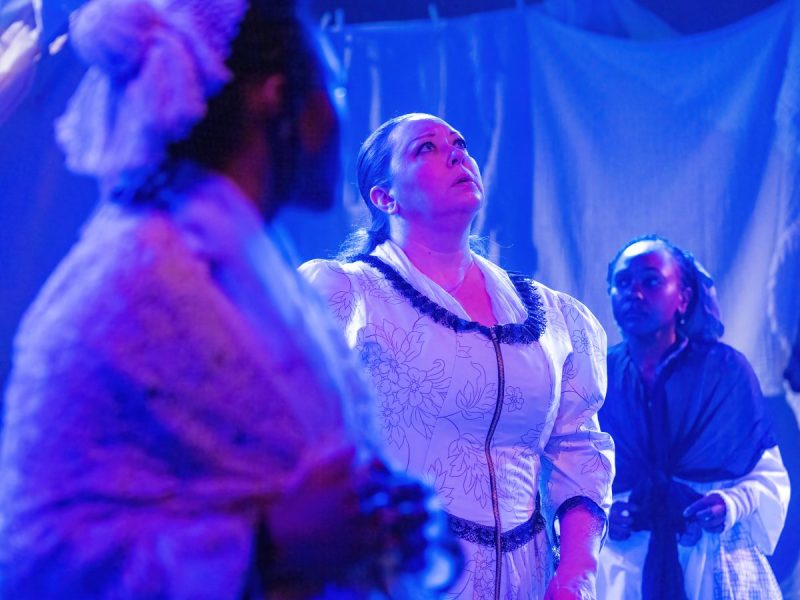
The three women characters that were written as women are tougher roles to pull off in the 21st century. Erin Brown as Hildy’s fiancee, Victoria Mitchell as her mother, and Alexis Avitia as Molly Malloy, a witness to the central crime, are all written as either unreasonable, hysterical, or dim. Brown, Mitchell, and Avitia do what they can with what they are given but can’t help falling into outdated stereotypes. And that’s not entirely their fault.
City Desk
The staging by Graziani was particularly adept here. Everyone treated the space as realistically as possible (moving about when the tension is high, flopping into chairs when frustrated, leaning against window sills for a smoke) while still keeping the scene pleasing to the eye. A notable moment is when, at the drop of a hot tip, the room clears of noisy journalists, and what is left is a mess of papers, cards, hamburger wrappers, and toppled phone receivers. After the maelstrom, in walks a winsome Mary Piona as Jennie the cleaner, looking at the mess with a sigh. It’s a breathing moment in an otherwise breathless play, something Graziani takes full advantage of at key moments in the production.
The design is a general “early 20th century” look that isn’t very specific regarding the 1920s, 30s, or 40s, but I didn’t mind it. The costumes by Ginger Kay Lewis-Reed are very nicely fitted, and David Pierce’s textured set design is really terrific, one of the best I’ve seen at 2nd Space in some time. I even enjoyed the subtlety of the lighting design by Joie Adams, which gave a slight sepia tinge and achieved a very nice, even wash across the stage.
Copy desk cuts
In its overall themes and storytelling style, “Front Page” holds up pretty well. But there are elements that make it a good candidate for a full adaptation, mostly in terms of a greater awareness of the bigotry and misogyny embedded in the play. As it is in the public domain, I’d love to see that happen (as it did in a 2016 Broadway revival directed by Jack O’Brien). While I’m sure the most egregious offenses were edited in this production, the whole approach to the script needs an overhaul.
In 1928, a play that so openly shows the venality of the system would have been pretty revelatory. Playing it for the 21st century, the script would benefit from showing the bigotry and misogyny through a more critical lens. You don’t have to get rid of it to contextualize it better for a modern audience. And some of that was hinted at in this production.
For example, much of the gender-swapped casting worked just fine. The themes already in this script could illuminate aspects of women in the workplace, media clickbait, the influence of the African American voting bloc, and the ethical choices white-collar workers have (and don’t have), both then and now.
Few characters in “The Front Page” are idealistic, nor do they have a heart of gold. But if you like stories about fast-paced newsrooms that spotlight (no pun intended) the systems and failures of the world, this production could be a pleasing night out.
“The Front Page” runs at the 2nd Space Theatre through June 21st. Please note that this production includes dramatic use of profanity and biased language.
The Munro Review has no paywall but is financially supported by readers who believe in its non-profit mission of bringing professional arts journalism to the central San Joaquin Valley. You can help by signing up for a monthly recurring paid membership or make a one-time donation of as little as $3. All memberships and donations are tax-deductible.


Steph
“as bright as a side street in Old Fig”
That’s high quality right there.