



Fresno Philharmonic returns with a top-notch virtual concert
Not all pandemic performances are created equal. One crucial thing: the timing. Back in July, an orchestra might have gotten away with a Zoom concert that didn’t look or sound great simply because of the goodwill of the audience (people hadn’t been able to attend a concert in a long time) and the novelty of the experience (look, the Zoom squares bounce around!)
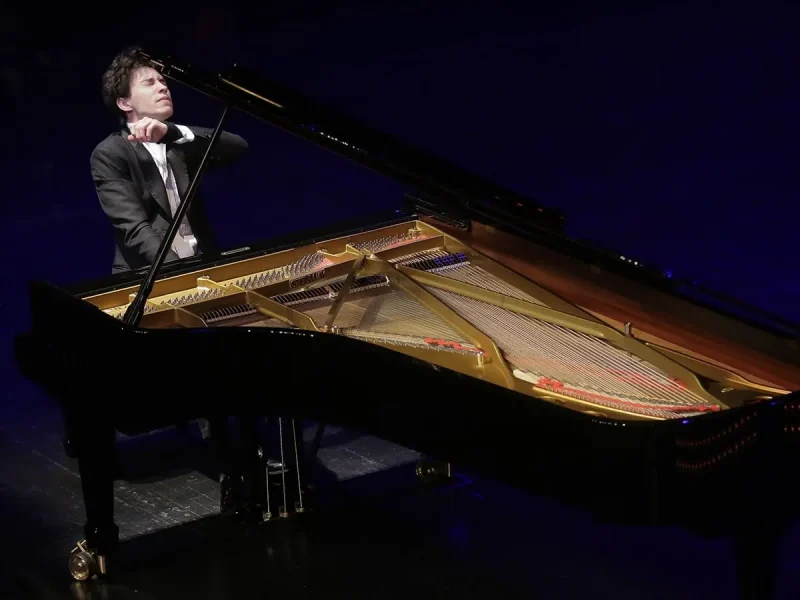
Pictured above: Views from the Fresno Philharmonic’s first concert of its Digital Masterworks Series, which debuts Jan. 16.
But it’s January now. Expectations have soared. Music software for live, simultaneous performance is much improved compared to the early days of the pandemic. For recorded concerts, production values are likewise higher. People aren’t as tolerant of amateur looking material as they were six months ago. They don’t want a mediocre substitute for hearing something live in a concert hall.
Rei Hotoda, music director of the Fresno Philharmonic, knows all this. So when it came time to plan the Digital Masterworks Series (the first free installment debuts on YouTube at 5:30 p.m. Saturday, Jan. 16, and will be viewable on demand thereafter), the orchestra wanted to make sure it was the highest quality possible.
Related story: Donald’s Top 20 cultural events of 2020
“I wanted to let the Fresno community know that we are going to do everything we can to perform for you,” Hotoda says. “We wanted to do something that looks and sounds really good.”
It does. The orchestra made an advance recording of the 42-minute concert available for me to view, and I’m very impressed. I was able to stream the video to my big-screen TV. The music sounds rich, full and exceptionally well balanced. (There are a few wobbles musically, but under the circumstances, that’s to be expected.) The visuals look great. In the able hands of Tritone Media, a video production company based in Moraga, the camera work and editing is superb. The best part is that the performance gives Fresno Philharmonic fans a chance to experience a concert from a close-up perspective.
STORY CONTINUES AFTER SPONSORED CONTENT


“You have the best seat in the house for these concerts,” Hotoda says. “You’re literally inches away from Stephanie Sant’Ambrogio, our concertmaster. You can see her left-hand fingering. In that way, it’s a very intimate concert. You are moving amongst the orchestra.”
As Hotoda reminds me, nothing really replaces live music. But this is the next best thing.
Here are some notes about the concert and a look behind-the-scenes at the production.
The precautions
We all know about masks and social distancing. Needless to say, all those coronavirus precautions had to be built into the rehearsals and filming sessions held in December at Shaghoian Concert Hall. Two Covid-19 safety officers oversaw the restrictions, which included spacing the musicians the appropriate distance apart on the stage (thus limiting their number), having string and percussion players (and the conductor) masked at all times, administering Covid-19 tests to brass and wind players and breaking for 15 minutes every hour to let air recirculate.
“It was completely new territory for us,” Hotoda says. “For the players, it was extremely challenging to sit so far apart from their (music) stand partners.”

Players’ glasses fogged up because of the masks. Chin rests for the string players kept pushing masks forward. And because of the increased breaks, time was extremely tight, so there was pressure to play it right the first time.
Vincent Keenan, the orchestra’s technical director, even devised a special structure for Hotoda’s podium that extended out from the stage like a peninsula, which increased the number of players allowed on stage.
The filming
Tal Skloot, the founder of Tritone Media, is a trained musician himself and over several decades has done video production work with musical ensembles across the state, from small choral groups to the San Francisco Symphony. (He produced a 2014 documentary film for KQED titled “Freeway Philharmonic”; you can still watch it online.) As you might expect, he’s been extremely busy since the pandemic began as orchestras search for digital ways of reaching their audiences.
Stephen Wilson, the orchestra’s CEO, recommended Tritone for the job.
Skloot wanted to make the production feel unique to Fresno. He incorporates drone photography of the local area, including agricultural and urban scenes, into the concert introduction. (Let me tell you, between the gorgeous aerial shots of Fresno in this production and the ones in the new Fresno City College film about the pandemic that just premiered, the city has never looked better.)
“One of the really specific things to this partnership that was great is that both Stephen and Rei were both extremely open to making this a collaboration,” he says. “We all worked together and ended up on all being on the same page. Hats off to them both.”
Most important was the six-person professional crew and seven high-end video cameras used for the filming. Risers were built to get better angles for various cameras.
“What I really wanted was a video that made you feel immersed, and see things you couldn’t see in a regular production,” Skloot says.
A jib-arm crane with camera attached captured motion. Most distinctive: A camera at the rear of the stage pointed toward Hotoda.
These views of the conductor from the orchestra’s perspective is one of the most memorable things about the filming. Even if you sit in the front row of the Saroyan Theatre for a Masterworks concert, you still aren’t going to get that angle.
“It adds something the audience never sees,” Skloot says.
For sound, Skloot hired David Bowles, a Grammy-winning sound recordist. “If you listen to his mix on headphones, you’ll notice a surround-sound feel,” Skloot says.
The music
There are three pieces on the program. The first is from a familiar composer: Adolphus Hailstork, who visited Fresno last year for the premiere of his piece “To Those Who Serve.” His piece in this concert, “American Fanfare,” speaks to the strength and resilience of the country, Hotoda says.
For the conductor, it was important to make a statement about the Black Lives Matter movement. “One of the things I decided to do was include a black composer on each concert,” she says. “I think that working with Adolphus last year in our season was fantastic, and I wanted to bring a composer that Fresno had met before. I wanted to present something that really represented our time.”
An important note about the Hailstork piece: It’s performed by the orchestra’s brass players. Hotoda wanted to provide equity for her players. Because brass and wind players blow through their instruments, the Covid-19 risk is even greater and precautions even more stringent, and the temptation for an orchestra to focus exclusively on strings. She didn’t want to do that.
The second piece is a fun whirlwind that marries past and present: “Commedia for (Almost) 18th Century Orchestra” by William Bolcom, another living American composer. The title suggests an 18th century orchestra, but it was, of course, written in the 20th century, adding piano and percussion, and offers a mix of styles, including modernism and the tarentalla.
 Some fun sound effects to listen for: when pianist Jason Sherbundy stands up and pounds on the piano’s actual strings; and when the oboe players take out their reeds and make a shrieking sound. (It actually startled me.)
Another thing besides the comic bits attracted Hotoda to the Bolcom. “It’s the energy of this piece, it’s kind of frenetic.” She relates it to the cooped-up feeling that many of us have during the pandemic. “So many of us are staying at home, frustrated, including a piece like this kind of gives us an emotional release because these times are so crazy.”
The final piece is the beautiful Haydn Symphony No. 44, also known as the “Mourning Symphony.” In the first two movements Haydn uses E minor as the key; it’s only in third movement that it goes to E major. Thus the piece has an emotional resonance as it goes from dark to light. “It’s an emotional piece,” Hotoda says. I thought it was really fitting to do a Haydn Symphony in particular. It’s not often played.”
The editing
In a “regular” concert, Hotoda takes her final bows, and that’s it. The performance is behind her. But in a taped presentation such as this, there’s still a lot of work ahead: taking the footage from all those cameras and editing it into a pleasing whole.
After the recording session, Hotoda raced home and spent three hours listening, making copious notes for Skloot. While she had plenty of suggestions, however, she knew the best thing is to rely on your editor.
“Luckily, I really trusted Tal and his editing abilities,” she says.
When you’re watching a live concert, it’s up to the individual viewer to “edit” the experience. You choose where to look and what to focus on. But in a piece of filmed entertainment, the editor makes those choices for you.
It took two weeks for Skloot to do the job.
The Munro Review has no paywall but is financially supported by readers who believe in its non-profit mission of bringing professional arts journalism to the central San Joaquin Valley. You can help by signing up for a monthly recurring paid membership or make a one-time donation of as little as $3. All memberships and donations are tax-deductible.
How did he choose the shots?
“It really is about capturing the feel of each piece and movement. The editing is dictated by the feel and tempo of the piece. Yes, you want to be on the right instrument when there’s an instrument that enters. But you also want it to feel visceral, so that each movement has a different tempo.”
If you pay attention, you’ll notice the allegro movement of the Haydn has twice as many edits.
How to watch
Best bet: Go to the orchestra’s website. At 5:30 p.m. Saturday, Jan. 16, you can watch the concert on an embedded YouTube player there. There are also instructions on ways you can watch directly on YouTube, on your Smart TV, or on Xfinity or the Dish Network. If you watch the premiere, you’ll get the added bonus of being able to live chat with Hotoda live. (Can you imagine — being able to “talk” during a concert, and with the conductor!) After the premiere, you’ll be able to watch the concert on demand, just like any other YouTube video.
What’s ahead
This is the first of four Digital Masterworks concerts planned. The second one, titled “American Visions,” will premiere Feb. 20.
All four concerts were scheduled to be rehearsed and filmed in December. However, the orchestra was only able to get in half the filming needed before the county was forced to go into a higher Covid-19 tier, effectively shutting production down. For now, fingers are crossed that the pandemic situation improves and that additional recording can take place for the third and fourth concerts.
Still, Hotoda is very pleased that the orchestra was able to get the first two concerts in the can. For her, the most important thing is letting the community know that the Fresno Philharmonic is hard at work figuring out ways to continue to connect with the community.
And nothing can beat that moment in December when she gave that first downbeat at Shaghoian Hall.
“It was so much more important to do this than a regular Masterworks concert,” she says. “We were so thrilled to hear live music. We take so much for granted.”