




With a new book-length poem, Juan Felipe Herrera offers a ‘Chicano Howl’ against immigration cruelty
By Doug Hoagland
Juan Felipe Herrera – a Valley icon as one of the nation’s most celebrated poets – confronts in a new work the “constellation of problems and pain” inflicted by America’s cruel leaders on immigrants.
His place in American culture is undisputed. From 2015-17, he served as Poet Laureate of the United States.
The son of a farmworker family, Herrera told The Munro Review: “I’m talking to America. These are human beings – children and families – coming thousands of miles to get here, and they’re dying in the desert or being pushed into detention camps. I believe in kindness and compassion. This is that kind of project.”
The project is “Flourishing Shadows Sombras Florecientes: A Chicano Howl.” It is a book-length poem with matching English and Spanish verse as well as pen and ink drawings.
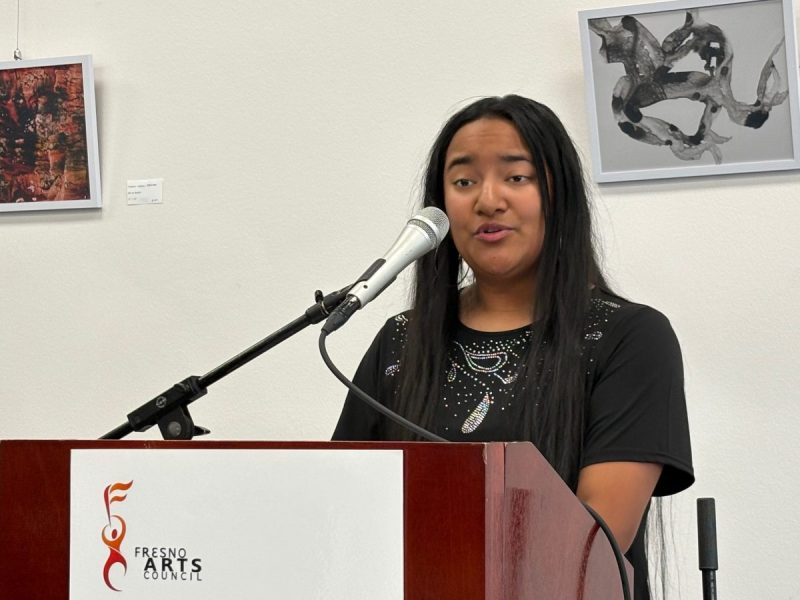
Family, friends and fans gathered at Fresno State on Nov. 9 to celebrate the publication of the poem. To an audience of about 100, he read excerpts from the poem.
One of the excerpts:
STORY CONTINUES AFTER SPONSORED CONTENT

do not think we are invisible we are
the brilliant minds living creating a brave new way
the world system is our system the galaxies are
our breath here now here now we almost have arrived
there will be no Mass Deportations
tired & hurting by walking we flourish under el sol
tired & hurting by walking we flourish under el sol . . .
America are you listening
‘A champion’
 Doug Hoagland / The Munro Review
Juan Felipe Herrera acknowledges his audience at his recent book event.
“Juan Felipe Herrera speaks on behalf of the underdog, especially the immigrants, those flourishing shadows that wander through the pages of his book,” writes Lauro Flores in the book’s Foreward. Flores is Professor of Chicano and Latin American literatures and cultures at the University of Washington, Seattle.
Flores, who translated the poem into Spanish, continues: “Over the last fifty years, Herrera has been a champion for the weak and vulnerable and a steadfast advocate of using art to promote global peace, harmony, and human understanding for the sake of our collective survival.”
The new poem is both personal and political. Herrera was born in Fowler, on the outskirts of Fresno, in 1948. “The son of migrant farmers, Herrera moved often, living in trailers or tents along the roads of the San Joaquin Valley,” according to poets.org. While attending the University of California, Los Angeles, he joined the Chicano civil rights movement.
Herrera later earned a Master of Fine Arts degree from the prestigious University of Iowa Writers’ Workshop and today is a professor emeritus at Fresno State and at University of California, Riverside.
Lee Herrick of Fresno, the current poet laureate of California. told the Fresno State audience: “Sometimes we run the risk of taking for granted greatness when it’s in proximity to us. In my humble opinion, he’s a national treasure and never to be taken for granted.”
One audience member, Isaiah Watkins, a 21-year-old Fresno State student, said in an interview that Herrera is speaking courageously at this moment in the nation’s history. “I think about how much fear and harm there is now. It’s brave to step up with politics being so dangerous.”
‘It is our land’
Reading from another passage in “Flourishing Shadows Sombras Florecientes,” Herrera said:
I am howling
can you hear me America
I am bowing you can see me
can you feel me . . .
It’s time you take down the walls
fences and funky patrol stops in the middle of nowhere
asking for papers asking for green cards & our soul
did you forget American are you a legal citizen
this is Indian land this is Mexican land
We are America We are all America
it is not easy America
we still remember we still have the songs & stories
we know the trails it is not the Border
it is our land
As he read to the audience, Herrera would sometimes spontaneously add a new line.
“I would definitely say he improvised a lot,” said Jefferson Beavers, communication specialist in the Fresno State English Department. Beavers moderated the event, which was sponsored by the Fresno State Library and the College of Arts and Humanities. “Juan Felipe’s poetry has always been free-flowing. I think in his later career, that free-flowing feeling has really ramped up and that’s where he’s in his element,” Beavers said.
‘We want to be heard’
The audience also included members of Herrera’s Ohuaya Collective, a group of older adults that meets with him once a week at Fresno State to explore poetry and artistic expression. Ohuaya is a rhythmic refrain or litany from classical Aztec and Mesoamerican poetry, sacred songs and ritual chants.
The Fresno State event was designed for Herrera and members of the Collective to engage in a call and response. He would say a line, and they would respond. When the audience joined in with the Collective’s response, the crowd became like a giant chorus.
At one point, members of the Collective joined Herrera in impromptu dancing before the audience.
The Munro Review has no paywall but is financially supported by readers who believe in its non-profit mission of bringing professional arts journalism to the central San Joaquin Valley. You can help by signing up for a monthly recurring paid membership or make a one-time donation of as little as $3. All memberships and donations are tax-deductible.
“It was a celebration of the launch of a new book, and the book is about a very serious set of issues that Juan Felipe takes seriously and has lived and continues to live,” said Jackie Ryle, a member of the Ohuaya Collective.
“But that didn’t negate the joy of being together. Juan Felipe has a joyous nature, and he brings out the joy in others. We feel and experience the joy that he emanates.”
Artistic expression of all kinds brings him joy. And, furthermore, it’s vital, Herrera told The Munro Review. “We need writers, poets, dancers, thinkers – all of us – to express ourselves. Our inner voice. The truth of what we want. We want to be heard. We want to be seen. We want to be read. It’s for the benefit of everyone.”
Editor’s note: The Munro Review extends its deepest condolences to Juan Felipe Herrera, his family and friends on the passing of Margarita Luna Robles, on Friday, Nov. 13. Robles, an iconic poet and performance artist in her own right, was Herrera’s closest and most impactful creative partner for decades.


Aileen Rodriguez Imperatrice
Thank you Doug. A very good roundup of this event and the emotion behind Juan Felipe’s writing. We were glad to participate in his celebration! And thank you for your mention of the passing of Margarita, she was a powerful force in the world and we are better for having her in it.
Aileen Rodriguez Imperatrice
Jackie Ryle
Thank you, Doug, for this fine recap of a wonderful event to celebrate Juan Felipe’s newest book. He is indeed a true force of nature, and a continuous source of inspiration for all of us. We share in the condolences for the passing of Magarita, a remarkable poet and activist in her own right.
Do come visit the Collective in the Laureate Lab