



Theater Review: In Fresno State’s ‘Is This a Room,’ reality falls through the looking glass
by Heather Parish
The essential problem with staging a play about an interrogation is that interrogations are inherently dull. They have to be dramatized, heightened, condensed and offer a big reveal for them to work in the narrative.
Instead, “Is This a Room,” an engaging piece of theater vérité (and also the basis for the film “Reality” with Sydney Sweeney), opts for the opposite and makes it work. Developed by Tina Satter and ably directed for Fresno State’s University Theatre by Michelle Bellaver, the play uses the transcript of the FBI interrogation of 25-year-old Reality Winner, played affectingly by Melanie Desirre. Why? Winner is the NSA intelligence contractor who leaked a classified report to the media indicating that there was Russian interference in the 2016 U.S. presidential election.
Yes, that Reality Winner (her real name). She was subsequently sentenced to the longest-ever term for such a crime and ushered in a decade of topsy-turvy election controversy.
“Curiouser and curiouser …” — Tweedledee
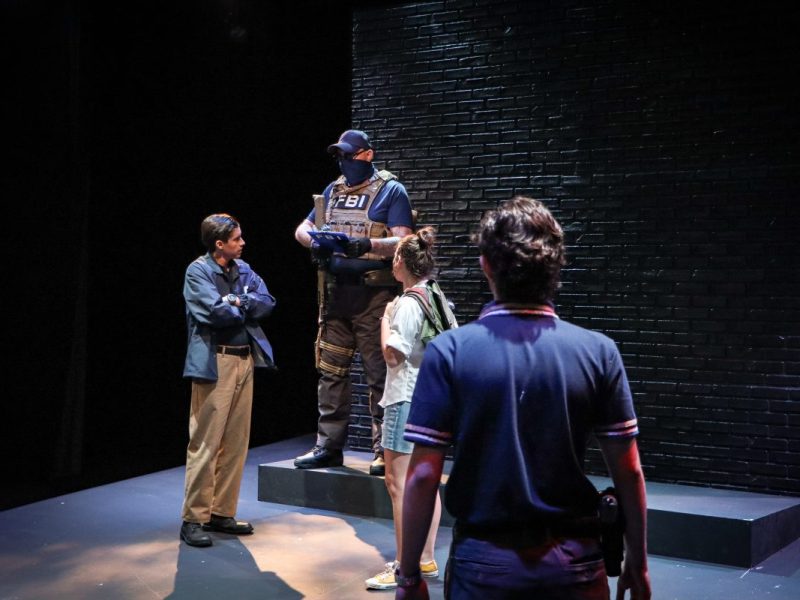
There’s a lot of drama inherent in this situation, and even more unfolds — methodically, systematically — throughout the 70 minutes of questioning Winner experiences in her own home. Two agents (Ronnie McClure and Sage Rivera) handle the questions but fail to Mirandize her. She cooperates and fails to call a lawyer. Meanwhile, a third “unnamed male” agent (Sean Torres) oversees the search of her belongings, babysitting her overweight cat while holding an assault rifle. It is all very surreal, very “Alice Through the Looking Glass.” “Reality in Surreality,” if you will.
That the dialogue is taken completely verbatim from the agents’ body-mic recordings heightens the tension. Their banter is so banal, their questions occasionally confusing, stalled by “ums” and arbitrary pauses, that it creates a frustrating lack of rhythm that’s palpable. Agents Garrick (McClure) and Taylor (Rivera) take a full 20 minutes chatting with Winner to create rapport. It is a tactic to stall for the warrant’s arrival as much as to try to put their subject at ease. But their chummy questions and attempts to find common ground are belied by their need to control her movements. This contradiction only increases Winner’s anxiety, especially for her foster animals inside.
“It’s a poor sort of memory that only works backwards …” — The White Queen
By the time the agents guide her into an empty room in her home (one she’s admitted to finding “creepy”), Winner is primed to keep answering questions, already exhausted. Desirre delivers a carefully calibrated performance that balances anxiety and self-preservation very well. In a play where the language work is even harder than usual (because it isn’t crafted for an actor’s delivery but is a real, imperfect conversation), she handles the trick with aplomb. She holds back, guarded, and yet her sense of resignation begins to seep out as she gets cornered again and again.
STORY CONTINUES AFTER SPONSORED CONTENT


McClure and Rivera also hold a diametric balancing act between “Hey, we’re just here to figure this out” casualness and the Caterpillar-like repetitions of “Did you print that out?”, “You didn’t take it from the building?” and “You put it in the burn bag?” (Who are you? What do you mean by that? Explain yourself!). Torres’ presence as the anonymous agent with a very big gun offers its own effective twist: He’s the primary source of comic relief while also being the most threatening person on the stage.
“If that there King was to wake, you’d go out — bang! — just like a candle!” — Tweedledee & Tweedledum
Bellaver’s direction often makes the most of these opposing structures within the text. The stage is a black brick wall at the top of a raked ramp (designed by Jeff Hunter) that positions the characters’ power imbalances in stark contrast to one another. The brick wall is a representation of Winner’s home, but in a few pivotal moments it looks more like the scene of a fascist firing squad. Lighting design by Brandi Martin and sound design by Thomas Barile enhance the moments of tension with deeply ominous ambience. They also found a clever way of noting the redactions in the interrogation transcript that simultaneously increases our unease. Costumes by Maggie Walker are precise and not overly elaborate. Just enough to frame these complicated characters in a complicated plot.
“Contrariwise …” — Tweedledee
My main concerns with the production are that at some points the exceedingly naturalistic language is hard to hear when the actors are turned upstage or when we can’t tell if a mumble is intentional. Though the language is verbatim, it still requires illuminating the verbal details. The audience needs clarity on what is important and what is intentionally left opaque. The interrogation also has its static moments, but these are forgivable in such an idea-rich and technically sound production.
Overall, Bellaver’s contradictions hold the thematic tensions in suspense admirably. It is a kind of mirror-image play where what you see depends entirely upon what you value politically, ethically and personally. When should secrets be kept? When is transparency paramount? When should a whistle be blown? And why? If you spend time with it long enough, through the looking-glass you may fall.
“Is This A Room” continues at the Dennis and Cheryl Woods Theatre at Fresno State through Oct. 10.