



The versatile saxophone gets a starring role in a concert featuring the Zephyr Quartet
By Donald Munro
The sax is sneaky. Just when you think you’ve pigeonholed it in the proper category (sultry, sexy, and, above all, jazzy) you expand your musical world to discover that the saxophone is an enthusiastic participant in the classical-music world as well.
For Jordan De La Torre, a teacher and lover of the instrument, it’s fun to spread the word about its versatility. He’ll get that chance on Friday, June 5, in a concert featuring the talents of the Zephyr Saxophone Quartet. The performance (7 p.m. at University Presbyterian Church, 1776 E. Roberts Ave., Fresno) is sponsored by the Fresno Musical Club, which is celebrating its 120 years of service to the community, and the Music Teachers’ Association of California-Fresno County Branch.
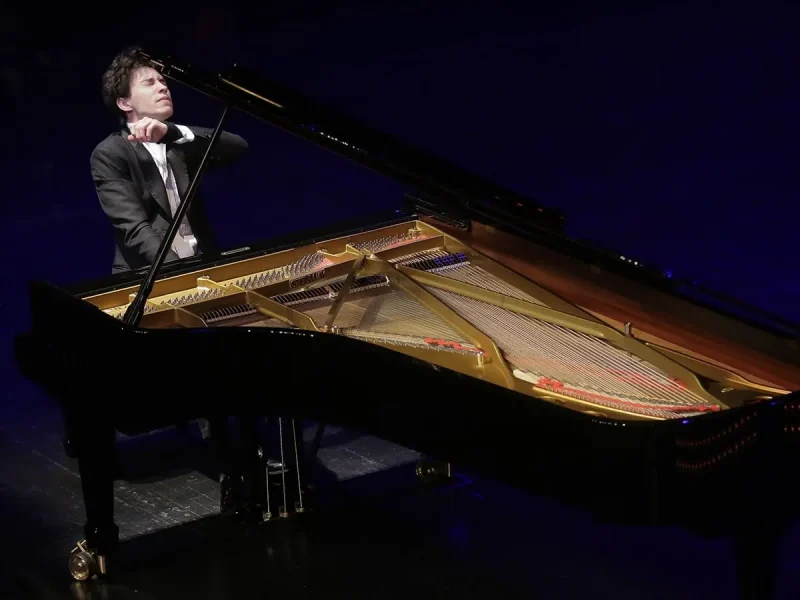
Pictured above: Jordan De La Torre is an evangelist for the saxophone Photo: Good Company Players
The students in the quartet – Alex Fisher (soprano), Hunter Hatfield (alto), Luke Noodmans (tenor) and Davin Whitleyall (bari) – are graduates of Clovis North High School. They perform at a very high level, indeed. The quartet in 2025 was the winner of the MANA Saxophone Institute High School Quartet Competition and advanced to the semifinals of the Fischoff Chamber Music Competition, one of the nation’s premier classical judging events.
A highlight in the program will be the premiere of Walter Saul’s “Pneuma,” a piece he dedicates to the quartet.
De La Torre is a special guest artist at the concert.
STORY CONTINUES AFTER SPONSORED CONTENT

I caught up with him for an invigorating email conversation.
Q: Tell us about your musical journey.
A: The flute was the first instrument I really learned to play. I do vividly remember the first time I felt it resonate, after struggling to get a sound out of it for days. It wasn’t just rewarding to finally get a real sound, it was weirdly fulfilling to feel the instrument vibrate in my hands and against my mouth. I didn’t expect that, but I loved it and knew I was hooked from that moment on. A little more than a year later I decided to switch to saxophone in my elementary school’s band, and today I still get the same fulfillment each time I feel the instruments vibrations.
Q: When you mention the saxophone, most people immediately think of jazz. But you’re into classical saxophone. What’s the difference?
A: What a lot of people don’t realize is that the saxophone was designed from the ground up to be a regular part of the orchestra. The history is a bit ludicrous and if you look into Adolphe Sax’s life, you’ll quickly realize that he was probably one of the least lucky people to have ever lived. When he took the saxophone to France, it became so overwhelmingly popular that rival instrument manufacturers did everything in their power to suppress it. I mean, they sued him for a stolen design, paid off orchestral musicians and composers to boycott the use of it, and there were even attempts on his life. The saxophone becoming a jazz instrument was actually by complete mistake and was a result of Sax’s rivals buying out his inventory and shipping it away from France, coincidentally to places like New Orleans. It was definitely a happy accident, though, and I think the best part about the saxophone is its versatility.
There are a lot of differences between classical and jazz playing, primarily in the sound. Classical playing is centered around maintaining the most pure, focused sound at all times regardless of the register or volume. Jazz playing leans into the imperfections and uses them as different colors. So, things that would be unacceptable in classical, like air in the sound, or the bending of notes, are part of what makes a jazz sound unique. It’s really something you have to hear in order to fully understand, and that’s one thing we plan to put on display at the concert. I actually do a lot of jazz playing as well, not just classical. I really love both and think that every saxophone player should do at least a little bit of each.
Q: The Zephyr Quartet’s concert is sponsored by the Fresno Musical Club, which has been around for 120 years, or approximately 12 times as long as you’ve been playing the saxophone. How did the quartet get involved with this longtime cultural organization?
A: What’s even crazier is that the FMC has existed for a majority of the time that the saxophone has. A little over a year ago, we were preparing for Zephyr’s first time at Fischoff and I wanted to get them more performance opportunities in order for them to be more comfortable with their repertoire. I reached out to FMC asking if they were interested in having Zephyr perform at one of their meetings, they invited them out, loved the performance, and now we’re here. I think recognizing that this organization predates almost all of the legendary players we look up to makes it that much more meaningful.
 Edgar Velasquez
 Q: Tell us about the four players in the quartet and your own role with the group.
A: The four of them are all private students of mine that just graduated from Clovis North, which was my high school as well. Luke was actually my first private student. I started teaching him during my senior year of high school and the rest followed not long after. They formed as a quartet in their sophomore year and I started coaching them more or less regularly. Heading into their junior year, I started encouraging them to look into some of the major chamber music competitions like Fischoff, and they were all for it. Aside from being a great group, they’re all top-notch individual musicians and some of them have won the first chair in the top California all-state band in the past two years. All four of them are also heading to top schools for saxophone next year. I think the best thing, and what’s really special, is that the four of them are practically like brothers. They’re always hanging out and having fun with or without the horns, and I think they really push each other to get better and better.
Q: The quartet made it to the semifinals of the 2025 Fischoff competition. How big of a deal is that?
A: Unfortunately, this year they missed the semifinals, but in 2025 they were one of seven groups in the world to get that far, which is a huge deal. Just being accepted to the competition’s live rounds is something very few people do, making it to semifinals is a step even higher than that.
Q: The concert also includes a piece by local composer Walter Saul titled “Pneuma.” It’s dedicated to the quartet, and I understand that the three movements celebrate three kinds of wind. Can you elaborate?
A: The name “Zephyr” comes from the Greek god Zephyrus and refers to a gentle breeze or a west wind. At Fischoff this was a nice touch because they were one of the only wind groups from the west coast. Walter’s inspiration to write about wind came from Zephyr’s name being to do with wind. The first movement depicts a gale, which is a strong and unrelenting current of wind. The second is called Zephyr, and is much more mellowed out and relaxed, again pulling on the idea of a gentle breeze. The third is entitled Paraclete. In Christian theology this refers to the Holy Spirit, and in the context of his piece, Walter refers to it as “the ultimate wind of energy, life, and exuberance.”
The Munro Review has no paywall but is financially supported by readers who believe in its non-profit mission of bringing professional arts journalism to the central San Joaquin Valley. You can help by signing up for a monthly recurring paid membership or make a one-time donation of as little as $3. All memberships and donations are tax-deductible.
Q: You just graduated from Fresno State and are returning for a master’s degree. Along with coaching Zephyr at Clovis North, you also work with younger students at three other high schools. What is it about teaching that you love?
A: I truly can’t think of any feelings more rewarding than watching my students grow and break new barriers. The moments where they look back and finally start to see and feel their own progress are genuinely the most exciting moments of my day. For students that have been with me for a long time, the feeling is even stronger because I’ve watched them grow into adulthood, and I got to be a part of their development throughout such formative years of their lives.
I started with just private teaching and a few students. Nothing really took off until after my first year of college. I started picking up a handful more students that summer, then got recruited by Clovis North to coach saxophone there. We never had a saxophone coach when I was there, but I always wanted one more than anything, so to get to be that was really special. Over time, more students reached out wanting lessons and more schools reached out wanting a coach. This past year I was coaching at Clovis North, Clovis West, Clovis East, and Clovis high, and had about 20 private students. When I started in high school, I would have never expected it to turn into this, but I’m really glad it has!
Q: Tell us one thing about the saxophone that most people don’t know.
A: Adolphe Sax, the inventor, was absolutely one of the unluckiest people ever. As just a child he accidentally drank sulfuric water, swallowed a sewing needle, fell three stories and landed on his head, almost drowned in a lake, fell into a brazier, got caught in a gunpowder explosion and more. And then there was his adult life, which wasn’t much better.
Q: If the saxophone were an animal in the jungle, what kind would it be?
A: My brain goes to a tiger. The way a tiger can move with so much grace, but on a dime be completely ferocious and violent. I think the saxophone does the exact same thing, and you’ll hear that in a lot of the pieces we do this Friday.