



Review: Good Company Players cracks the case with ‘Curtains’
by Heather Parish
There is something delectable about musicals that comment on how absurd musicals can be. They are simultaneously wry and winsome, cynical and sentimental. Add in a layer of classic whodunnits that comment on how absurd a murder mystery can be . . . you have a show that knocks ‘em dead (so to speak).
Good Company Players’ latest iteration of Kander and Ebb’s “Curtains” is a delightful respite from reality. As is the case with both musical comedies and murder mysteries, no matter how convoluted the plot or how shady the characters, the audience knows that everything is put to rights in the end.
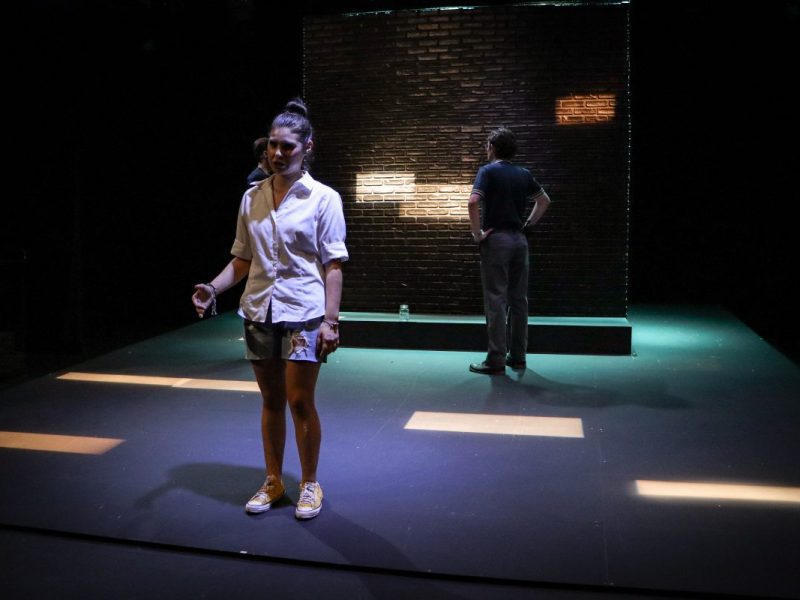
 Courtesy of Good Company Players
 Death takes a curtain call
The musical, which premiered on Broadway in 2006, is set in 1959 Boston, at the out-of-town run of the campy musical “Robbin’ Hood,” which is trying to get to Broadway. In the final preview, Jessica Cranshaw (Caitlin Sawastky), the incredibly untalented star, is killed during her curtain call. The entire company is full of potential suspects, including the director, the composers, the co-star, the producer, and the understudy. Before the performance reopens, Lt. Frank Cioffi (Shawn Williams), a police detective who also fancies musical theater, must solve the case, fix the show, and possibly find love without getting himself killed.
It has all of the trappings one loves in these shows: funny, whip-smart characters, budding love, love triangles, and plenty of red herrings to keep you guessing. (Identifying the killer early is one of my favorite things to do when watching a murder mystery. My first guess was correct! Some people just have a nose for it.)
 Courtesy of Good Company Players
 Every suspect a star turn
STORY CONTINUES AFTER SPONSORED CONTENT


Under the direction of Elizabeth Fiester, the ensemble is cohesive and focused with strong performances from several of Good Company’s veteran leads. Williams’ portrayal of Cioffi is earnest without seeming dopey. He’s particularly adept at switching from enthralled fan to the smartest guy in the room at the drop of a fedora. His “Coffee Shop Nights” solo expresses Cioffi’s rich inner life through Williams’ layered tenor, with a touching grace.
Emily Pessano as lyricist/retired actress Georgia is the most fully comfortable in this backstage-gone-mad world. The role requires the heaviest lift, the ability to play comedy and drama, to dance, to harmonize, and to belt in her upper range a couple of times. Pessano’s poise and impeccable timing are on full display in the role. As her composing partner and estranged husband Aaron Fox, Michael Fidalgo (who also coached the vocals) duels with Pessano admirably and delivers a touching “I Miss the Music.” As the third in their love triangle, Khari Sommerville’s Bobby Pepper is a leading dance man with high charisma and even higher energy.
Rounding out the company leadership is Steve Souza’s Christopher Belling, the classic auteur-director whose primary talents are dressing well and landing a cutthroat quip; and Kaitlyn Wheeler as understudy Niki (she shares the role with Dorie Hamby), Cioffi’s love interest, whose wholesomeness has just enough mystery to keep her in the frame for murder. And the standout number of the second act goes to “It’s a Business,” led by Jessica Sarkisian as Carmen, the producer/stage mom with a killer business sense and a heart of gold.
The supporting ensemble ably focuses on doing the meta work of being an ensemble playing an ensemble without once pulling focus. Which is what it takes to disguise the sort of prestidigitation needed to move props, redirect attention and do a quick change in under a minute (and cover up a murder in the meantime!)
 Courtesy of Good Company Players
 Staging the (crime) scene
If the production has a flaw, it is perhaps in the repetitious nature of the love ballads, which tends to slow down the action in the second act and doesn’t contribute much to the plot, and some rather retrograde representation that may be acceptable for 1959 but could have been better dealt with in 2006. But those are problems more with the book than with the performances here.
Fiester stages every moment with a thoughtfulness and seamless sense of movement. Every scene shift is fluid, and every scene plays like it is on a much larger proscenium stage. Choreographers Kaye Migaki and Steve Souza smartly address the limitations of the stage while keeping the movement fresh.
David Pierce’s set is tightly and efficiently designed, and costumes by Ginger Kay Lewis-Reed are beautifully deployed, including beautifully fitted suits and snatched-waist dresses that are a pleasure to watch.
All-in-all, “Curtains” is ably executed and a pleasant evening in a time when we need to drop our shoulders and lighten the caseload a bit.
“Curtains” continues at Roger Rocka’s Dinner Theater through July 19, 2026.